Why Manufacturers Around The World Should Manufacture Their Products In India
Your Innovative Product Is in Demand — But Is High Manufacturing Cost Limiting Your Global Success

Why Manufacturers Around The World Should Manufacture Their Products In India

The global manufacturing industry is going through a major transformation. Companies across the USA, Canada, Europe, UK, Australia, and other developed markets are searching for reliable manufacturing destinations that can offer high-quality production, competitive pricing, skilled manpower, and scalable capacity.

For decades, manufacturers competed mainly through innovation and technology. Today, another factor has become equally important:

Where and how a product is manufactured.

A great product can lose market advantage if its manufacturing cost is too high.

Increasing labour costs, rising operational expenses, strict environmental requirements, and supply chain challenges are forcing businesses to rethink their production strategies.

This is where manufacturing in India has emerged as a powerful global solution.

India offers a unique combination of:

  • Cost-effective manufacturing
  • Skilled engineering talent
  • Large industrial ecosystem
  • Advanced production capability
  • Growing technology infrastructure
  • Global export readiness

For international manufacturers looking to improve profitability and competitiveness, India is becoming one of the most attractive manufacturing destinations in the world.


The Global Need For Cost-Effective Manufacturing Solutions

Rising Manufacturing Costs Are Affecting Global Competitiveness

Manufacturers worldwide are facing increasing pressure due to:

Cost FactorImpact On Manufacturers
Labour cost increaseHigher production expenses
Energy pricesIncreased operational cost
Raw material fluctuationsUnstable product pricing
Supply chain issuesDelivery delays
Skilled workforce shortageProduction limitations

A company may design an innovative product, but if production cost is high, it becomes difficult to compete in international markets.

For example:

A manufacturer producing a product at a high cost may have to sell at a premium price. However, competitors with efficient production systems can offer similar quality products at better prices.

This directly affects:

  • Market share
  • Profit margins
  • Customer acquisition
  • Brand growth

Therefore, global businesses are exploring manufacturing partnerships in countries that provide both quality and cost efficiency.


Why India Is Becoming A Global Manufacturing Hub

Manufacturing In India Offers The Perfect Balance Of Cost And Quality

India has rapidly developed into one of the world’s preferred manufacturing destinations because it combines affordability with industrial capability.

Unlike the perception that low cost means low quality, modern Indian manufacturing focuses on:

  • Precision engineering
  • Quality control
  • International standards
  • Technology adoption
  • Process improvement

Today, India manufactures products for global markets across multiple industries including:

  • Automotive
  • Engineering
  • Electronics
  • Medical products
  • Consumer goods
  • Industrial equipment
  • Machinery components
  • Specialty products

India Manufacturing Advantages At A Glance

AdvantageBenefit For Global Companies
Competitive labour costReduced production expenses
Skilled workforceBetter manufacturing quality
Large supplier ecosystemFaster sourcing
Growing infrastructureEfficient production
Technical expertiseProduct development support
Export capabilityGlobal market access

Lower Manufacturing Cost In India Without Compromising Quality

Cost Advantage Is One Of The Biggest Reasons To Manufacture In India

One of the strongest reasons companies choose India is manufacturing cost optimization.

India provides access to skilled professionals at competitive costs compared with many developed markets.

Manufacturing Cost Comparison

FactorDeveloped MarketsIndia
Labour expenseHighCompetitive
Production overheadHighLower
Engineering resourcesExpensiveCost-effective
Manufacturing setupHigher investmentFlexible options
Production scalingCostlyEasier expansion

This cost advantage helps businesses:

  • Reduce product price
  • Increase profit margin
  • Invest more in innovation
  • Expand global reach

Skilled Workforce And Engineering Excellence In India

India Has One Of The World’s Largest Technical Talent Pools

A successful manufacturing ecosystem requires more than machines. It requires skilled engineers, technicians, designers, operators, and quality professionals.

India has millions of professionals working in:

  • Mechanical engineering
  • Manufacturing engineering
  • Industrial design
  • Automation
  • Electronics
  • Production management
  • Quality assurance

This talent availability allows companies to outsource production while maintaining technical control.


Engineering Manufacturing Capability In India

Why Engineering Companies Prefer India

Engineering-based industries require accuracy, consistency, and technical expertise.

Indian manufacturers support:

  • Component manufacturing
  • Precision machining
  • Assembly operations
  • Fabrication
  • Product customization
  • Industrial production

For companies searching for a reliable manufacturing partner, India provides a complete ecosystem from concept to final production.


Production Outsourcing: A Smart Strategy For Global Businesses

What Is Manufacturing Outsourcing?

Manufacturing outsourcing means a company partners with an external manufacturer to produce products instead of investing heavily in its own production facilities.

This model allows businesses to focus on:

  • Research
  • Marketing
  • Sales
  • Customer development

while the manufacturing partner manages:

  • Production
  • Workforce
  • Equipment
  • Process management

Benefits Of Manufacturing Outsourcing In India

BenefitBusiness Impact
Lower investment requirementReduced manufacturing risk
Flexible productionEasy scaling
Faster market entryCompetitive advantage
Expert production supportBetter efficiency
Reduced operational burdenBusiness growth

Quality Standards In Indian Manufacturing

High Quality Manufacturing In India For Global Markets

A common concern among international businesses is whether manufacturing in India can meet global quality expectations.

Modern Indian manufacturing has evolved significantly with advanced technology, automation, quality management systems, and international compliance practices.

Today, Indian manufacturers supply products to some of the world’s most demanding markets including:

  • United States
  • Germany
  • United Kingdom
  • France
  • Italy
  • Australia
  • Canada
  • Middle East markets

Quality-focused manufacturing includes:

  • Process control
  • Inspection systems
  • Material verification
  • Production monitoring
  • Final product testing
  • Packaging standards

The objective is simple:

Reduce cost while maintaining or improving product quality.


India’s Strong Industrial Supply Chain Ecosystem

Why Supply Chain Strength Matters In Manufacturing

A successful manufacturing location requires more than factories.

It requires a complete ecosystem including:

  • Raw material suppliers
  • Component manufacturers
  • Engineering service providers
  • Logistics companies
  • Packaging suppliers
  • Export support services

India has developed a large and diverse industrial network that supports multiple industries.

This allows companies to manufacture products efficiently without managing hundreds of independent suppliers.


Manufacturing Infrastructure Growth In India

India’s Industrial Development Is Creating New Opportunities

India has invested heavily in:

  • Industrial corridors
  • Transportation infrastructure
  • Manufacturing zones
  • Digital systems
  • Technology adoption

These improvements are helping manufacturers achieve:

  • Faster production cycles
  • Better logistics
  • Improved supply chain reliability

India Manufacturing Vs Other Manufacturing Locations

Global Manufacturing Comparison

ParameterHigh-Cost MarketsTraditional Low-Cost MarketsIndia
Labour CostHighLowCompetitive
Engineering TalentAvailable but expensiveLimited in some areasStrong
Production QualityHighVariableHigh with right partner
Scaling AbilityExpensiveModerateFlexible
Supplier NetworkStrongLimitedLarge ecosystem
Innovation SupportHighModerateGrowing rapidly

India provides a balanced manufacturing model:

Affordable + Skilled + Scalable + Quality Focused


Industries That Can Benefit From Manufacturing In India

1. Engineering And Industrial Products

Engineering companies require precision, reliability, and technical expertise.

India supports:

  • Machine components
  • Industrial equipment
  • Mechanical parts
  • Fabricated products
  • Custom engineering solutions

Manufacturing outsourcing allows engineering companies to reduce production costs while maintaining technical specifications.


2. Automotive Manufacturing

India has become a major automotive manufacturing destination.

The automotive ecosystem includes:

  • Component suppliers
  • Assembly units
  • Engineering specialists
  • Testing facilities

Companies can outsource:

  • Automotive components
  • Accessories
  • Mechanical assemblies
  • Customized parts

3. Electronics Manufacturing

Electronics manufacturing in India has grown significantly due to:

  • Technology investment
  • Skilled workforce
  • Government support
  • Growing supplier networks

Global brands are increasingly exploring India for electronics production.


4. Consumer Product Manufacturing

For startups and established brands, manufacturing in India provides opportunities for:

  • Private label products
  • Customized products
  • Brand manufacturing
  • Bulk production

This allows companies to launch products faster and more competitively.


Product Development And Manufacturing Support

From Idea To Market-Ready Product

Manufacturing is not only about production.

A successful product requires:

  1. Design understanding
  2. Material selection
  3. Production planning
  4. Manufacturing execution
  5. Quality inspection
  6. Packaging
  7. Delivery support

A reliable manufacturing partner helps transform ideas into commercially successful products.


Scalable Production Capability

Manufacture According To Your Business Growth

One of the biggest advantages of outsourcing manufacturing is flexibility.

A business may start with:

  • Small production batches

and later expand into:

  • Large-scale production

without investing heavily in:

  • Factory setup
  • Machinery
  • Workforce expansion

This makes manufacturing outsourcing suitable for:

  • Startups
  • SMEs
  • International brands
  • Established companies

Why International Companies Choose Artan International

Your Trusted Manufacturing Partner In India

Artan International, based in Ahmedabad, India, supports businesses looking for reliable manufacturing solutions.

We help product owners and companies with:

  • Manufacturing outsourcing
  • Production support
  • Job work solutions
  • Engineering manufacturing assistance
  • Supplier coordination
  • Scalable production services

Learn more about our manufacturing solutions:

https://artaninternational.biz/manufacturing-outsourcing-services-india/

Our goal is to help businesses achieve:

✓ Lower production cost
✓ Better market competitiveness
✓ Reliable quality
✓ Faster scaling
✓ Global business growth


Manufacturing In India: A Strategic Business Decision

The Future Of Global Production

The future of manufacturing will belong to companies that can combine:

  • Innovation
  • Efficiency
  • Quality
  • Cost control

India provides all these advantages together.

Companies that strategically use Indian manufacturing capabilities can improve their global competitiveness and build stronger businesses.

How To Start Manufacturing Your Product In India

A Simple Process For Global Businesses

Many companies think moving production to another country is complicated. However, with the right manufacturing partner, the process can become simple, structured, and efficient.

A professional manufacturing outsourcing process generally includes:

Step 1: Product Requirement Discussion

The first stage is understanding the product.

This includes:

  • Product specifications
  • Material requirements
  • Production quantity
  • Quality expectations
  • Packaging requirements
  • Delivery timeline

A clear understanding helps create an efficient production plan.


Step 2: Manufacturing Planning

After understanding the requirement, the manufacturing approach is developed.

This includes:

  • Production method selection
  • Cost estimation
  • Supplier coordination
  • Timeline planning
  • Quality checkpoints

The objective is to create the most cost-effective production solution.


Step 3: Production Execution

During production, important factors are monitored:

  • Manufacturing accuracy
  • Material quality
  • Production speed
  • Process efficiency

A strong production system ensures consistency from the first unit to large-scale manufacturing.


Step 4: Quality Inspection

Quality control is an essential part of global manufacturing.

Inspection may include:

Quality StagePurpose
Incoming material checkVerify raw material quality
Production inspectionMaintain manufacturing accuracy
Final inspectionEnsure finished product quality
Packaging inspectionSafe international delivery

Step 5: Delivery And Supply Support

After production completion, products are prepared according to customer requirements.

This may include:

  • Packaging
  • Documentation
  • Export coordination
  • Shipment preparation

Manufacturing Outsourcing In India For Startups And Growing Brands

Why New Companies Should Consider India Manufacturing

Startups often face challenges:

  • Limited investment
  • Small initial demand
  • Need for quick market entry
  • Pressure on pricing

Manufacturing in India helps startups avoid large infrastructure investments.

Instead of building a complete manufacturing facility, they can focus resources on:

  • Product improvement
  • Marketing
  • Sales
  • Customer acquisition

A manufacturing partner manages production requirements.


How India Helps Improve Global Product Competitiveness

Lower Cost Creates Market Advantage

A lower manufacturing cost provides multiple advantages:

Better Pricing

Companies can offer competitive prices in international markets.

Higher Profit Margin

Reduced production expenses improve business profitability.

Faster Growth

Saved resources can be invested into expansion.

Stronger Competition

Products become more competitive against global alternatives.


Manufacturing Cost Optimization Example

Business AreaWithout OutsourcingWith Indian Manufacturing Partner
Factory investmentRequiredReduced
Workforce managementRequiredOutsourced
Production managementInternal responsibilityPartner supported
ScalingSlow and expensiveFlexible
Market expansionLimitedEasier

Why Choose Artan International As Your Manufacturing Partner?

Reliable Manufacturing Outsourcing From Ahmedabad, India

Artan International helps international businesses access Indian manufacturing capabilities.

We work as a bridge between:

Global Product Ideas + Indian Manufacturing Expertise

Our services support companies looking for:

  • Product manufacturing solutions
  • Production outsourcing
  • Industrial job work
  • Engineering support
  • Supplier coordination
  • Manufacturing assistance

Whether you are launching a new product or expanding an existing production line, Artan International helps you manufacture efficiently.

Visit:

https://artaninternational.biz


The Future Of Global Manufacturing Is Collaborative

Manufacture Anywhere. Compete Everywhere.

The future of business belongs to companies that build smart global partnerships.

A company does not need to manufacture everything internally.

By choosing the right manufacturing destination and the right partner, businesses can achieve:

  • Better efficiency
  • Lower costs
  • Faster growth
  • Higher competitiveness

India has become one of the strongest destinations for global manufacturing because it combines:

✓ Skilled workforce
✓ Competitive cost
✓ Industrial capability
✓ Engineering expertise
✓ Growing infrastructure

For businesses worldwide, manufacturing in India is not only a cost-saving decision.

It is a long-term growth strategy.


Frequently Asked Questions (FAQ)

Is manufacturing in India suitable for international companies?

Yes. Many international companies manufacture products in India because of competitive pricing, skilled workforce, and strong industrial capability.


Does lower manufacturing cost mean lower quality?

No. Modern Indian manufacturing uses advanced technology, quality control systems, and professional processes to meet global expectations.


Can small businesses manufacture in India?

Yes. Manufacturing outsourcing is suitable for startups, small businesses, and large enterprises.


Can production quantity be increased later?

Yes. Scalable manufacturing allows companies to increase production according to market demand.


What industries can outsource manufacturing to India?

Industries include:

  • Engineering
  • Automotive
  • Electronics
  • Consumer products
  • Industrial equipment
  • Healthcare products
  • Customized products

Final Conclusion

Why Manufacturers Around The World Should Manufacture In India

The global market rewards businesses that can deliver:

  • Innovation
  • Quality
  • Competitive pricing
  • Reliable supply

India provides manufacturers with the opportunity to achieve all these advantages together.

With the right manufacturing partner, businesses can reduce costs, improve profitability, and compete successfully worldwide.

For companies searching for a reliable manufacturing outsourcing partner in India, Artan International provides professional support to help transform ideas into successful products.

Manufacture in India. Compete globally. Grow faster.

Related Posts
How an E-Commerce Support Agency Helps Online Sellers Grow, Manage & Scale Successfully-Artan International
How an E-Commerce Support Agency Helps Online Sellers Grow, Manage & Scale Successfully

How an E-Commerce Support Agency Helps Online Sellers Grow, Manage & Scale Successfully

Introduction: Why Online Sellers Need an E-Commerce Support Agency

The global e-commerce industry has transformed the way businesses sell products, reach customers, and build brands. Today, anyone can launch an online store through platforms like Amazon Seller Central, Shopify, Walmart Marketplace, eBay, Etsy, and other digital marketplaces. However, building a successful online business requires much more than simply uploading products and waiting for sales.

Modern online sellers face challenges related to:

  • Product listing optimization
  • Marketplace rules and compliance
  • Inventory management
  • Customer communication
  • Advertising campaigns
  • Order processing
  • Returns and refunds
  • Account health monitoring
  • Data analysis
  • Brand growth strategies

This is where an e-commerce support agency becomes a valuable business partner.

An experienced e-commerce support agency provides specialized operational, technical, and strategic support that helps sellers improve efficiency, increase revenue, and scale their online businesses.

Whether a seller operates in the USA, Australia, Canada, or international markets, professional e-commerce support can reduce operational workload and allow business owners to focus on product development and expansion.


What Is an E-Commerce Support Agency?

An e-commerce support agency is a professional service provider that helps online sellers manage and improve their digital commerce operations.

Unlike a basic virtual assistant, an e-commerce support agency combines:

  • Marketplace expertise
  • Technology knowledge
  • Customer service skills
  • Data analysis
  • Digital marketing understanding
  • Compliance management

A professional agency supports sellers throughout the complete e-commerce lifecycle.

Core Functions of an E-Commerce Support Agency

Marketplace Account Management

Major platforms such as Amazon, Walmart, Shopify, and eBay have strict seller requirements.

An e-commerce support agency helps sellers manage:

  • Seller account settings
  • Performance metrics
  • Policy compliance
  • Marketplace communications
  • Account health

For example, Amazon monitors sellers through metrics such as:

  • Order Defect Rate (ODR)
  • Late Shipment Rate
  • Cancellation Rate
  • Customer Response Time

Poor performance can lead to restrictions or suspension.

A dedicated support team continuously monitors these areas to maintain seller health.


How an E-Commerce Support Agency Helps Amazon Sellers

Amazon is one of the world’s largest online marketplaces.

According to Amazon, millions of independent sellers worldwide use Amazon Marketplace to reach customers.

Reference:
https://sell.amazon.com

Managing Amazon successfully requires knowledge of:

  • Amazon Seller Central
  • Amazon FBA
  • Amazon FBM
  • Brand Registry
  • Advertising Console
  • Inventory Dashboard
  • Account Health Dashboard

Amazon Seller Central Management Services

An e-commerce support agency can assist sellers with:

Product Listing Optimization

Successful Amazon listings require:

  • Keyword research
  • SEO-friendly titles
  • Bullet points
  • Product descriptions
  • Backend keywords
  • A+ Content

A properly optimized listing improves:

  • Search visibility
  • Click-through rate
  • Conversion rate

Amazon Inventory Management Support

Inventory problems are among the biggest challenges for sellers.

An e-commerce support agency helps monitor:

Inventory Issue Business Impact
Out of stock Lost sales ranking
Overstock Higher storage fees
Poor forecasting Cash flow problems
Slow-moving products Reduced profitability

For Amazon FBA sellers, inventory planning is especially important because Amazon charges storage fees.

Reference:
https://sell.amazon.com/fulfillment-by-amazon


Amazon Advertising Support

Amazon PPC (Pay-Per-Click) advertising has become essential for sellers.

An e-commerce support agency helps manage:

  • Sponsored Products
  • Sponsored Brands
  • Sponsored Display Ads
  • Keyword targeting
  • Campaign optimization

Important advertising metrics include:

Metric Meaning
ACOS Advertising Cost of Sales
ROAS Return on Advertising Spend
CTR Click Through Rate
CPC Cost Per Click

Professional management helps reduce wasted advertising spend.


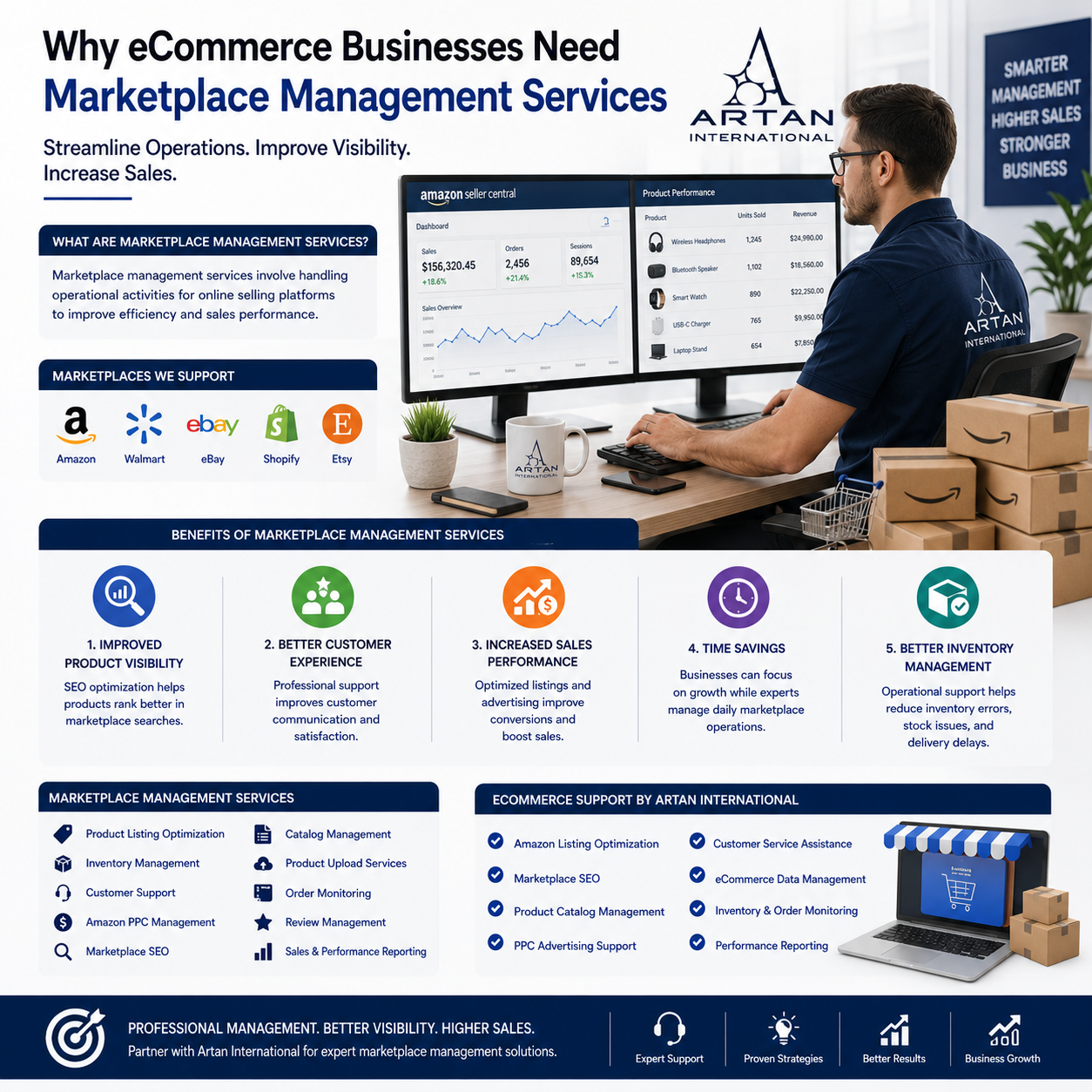
Shopify Store Management Support

Shopify has become one of the most popular platforms for independent brands.

Reference:
https://www.shopify.com

A Shopify seller must manage:

  • Website design
  • Product uploads
  • Payments
  • Shipping
  • Customer support
  • Marketing integrations

An e-commerce support agency helps with:

Shopify Product Management

Services include:

  • Product creation
  • Image optimization
  • Collection management
  • SEO descriptions
  • Inventory updates

Customer Support: A Major Role of an E-Commerce Support Agency

Customer experience directly affects online success.

According to many marketplace studies, customers expect fast responses and smooth service.

A professional e-commerce support agency manages:

  • Customer emails
  • Chat support
  • Refund requests
  • Return processing
  • Complaint resolution

Why Customer Support Matters

Good customer service improves:

  • Reviews
  • Ratings
  • Repeat purchases
  • Brand reputation

Poor customer service can damage marketplace ranking.


E-Commerce Support Agency Services Comparison Table

Service Amazon Shopify Walmart eBay
Product Listing ✓ ✓ ✓ ✓
Customer Support ✓ ✓ ✓ ✓
Inventory Management ✓ ✓ ✓ ✓
Advertising Support ✓ ✓ ✓ ✓
Account Monitoring ✓ ✓ ✓ ✓

Walmart Seller Center Support Services

Walmart Marketplace has become a major competitor in the global e-commerce industry. For sellers targeting customers in the USA and Canada, Walmart Seller Center provides an opportunity to reach millions of shoppers.

Reference:
https://marketplace.walmart.com/

However, managing Walmart operations requires attention to:

  • Product catalog accuracy
  • Competitive pricing
  • Order fulfillment
  • Seller performance standards
  • Customer communication
  • Marketplace compliance

An e-commerce support agency helps sellers manage Walmart Seller Center efficiently.


Walmart Marketplace Management by an E-Commerce Support Agency

A professional agency can assist with:

Product Catalog Management

Walmart requires accurate product information including:

  • Product titles
  • Descriptions
  • Specifications
  • Images
  • Category attributes
  • Pricing information

Incorrect product data can reduce visibility and create listing errors.


Order & Fulfillment Management

Online sellers must maintain excellent fulfillment performance.

An e-commerce support agency monitors:

Area Purpose
Order processing Faster customer delivery
Shipment tracking Better customer experience
Cancellation monitoring Maintain seller score
Returns management Reduce disputes

eBay Seller Support Services

eBay remains one of the most established online marketplaces.

Reference:
https://www.ebay.com/sellercenter

Selling successfully on eBay requires:

  • Optimized listings
  • Competitive pricing
  • Customer communication
  • Inventory accuracy

An e-commerce support agency helps sellers manage daily eBay operations.


eBay Listing Optimization

A strong eBay listing includes:

  • Search-friendly title
  • High-quality images
  • Detailed specifications
  • Accurate categories
  • Buyer-focused descriptions

Proper optimization improves:

  • Search ranking
  • Buyer trust
  • Conversion rates

Etsy Seller Support for Handmade & Specialty Products

Etsy focuses heavily on:

  • Handmade products
  • Crafts
  • Vintage items
  • Customized products

Reference:
https://www.etsy.com/seller-handbook

An e-commerce support agency helps Etsy sellers with:

  • Keyword optimization
  • Product uploads
  • Customer messages
  • Order tracking
  • Review management

The Importance of E-Commerce SEO for Online Sellers

A successful online store depends heavily on visibility.

An e-commerce support agency helps sellers improve search ranking through:

  • Keyword research
  • Product optimization
  • Content improvements
  • Marketplace SEO

E-Commerce SEO Activities

Activity Benefit
Keyword research Finds customer search terms
Listing optimization Improves ranking
Content improvement Builds trust
Image optimization Increases engagement

E-Commerce Support Agency and Data Analytics

Successful sellers make decisions based on data.

A professional agency analyzes:

  • Sales reports
  • Customer behavior
  • Product performance
  • Advertising results
  • Competitor pricing

Important E-Commerce Metrics

Metric Importance
Conversion Rate Measures sales effectiveness
Average Order Value Shows customer spending
Customer Acquisition Cost Marketing efficiency
Profit Margin Business sustainability
Return Rate Product satisfaction

How an E-Commerce Support Agency Reduces Business Costs

Many sellers initially try to manage everything themselves.

This often creates problems:

  • Time loss
  • Operational mistakes
  • Missed sales opportunities
  • Poor customer service

Outsourcing to an e-commerce support agency provides access to skilled professionals without hiring a full internal team.


In-House Team vs E-Commerce Support Agency

Factor Internal Team E-Commerce Support Agency
Hiring cost High Flexible
Training requirement Required Already skilled
Marketplace experience Limited Specialized
Scalability Slower Faster
Technology access Additional cost Included

Real Examples of E-Commerce Growth Through Marketplace Support

Example 1: Amazon Brand Growth

A small brand selling consumer products may struggle with:

  • Low ranking
  • Poor PPC performance
  • Inventory issues

With professional Amazon support:

  • Listings improve
  • Advertising becomes optimized
  • Inventory planning improves
  • Customer experience increases

Example 2: Shopify Store Expansion

A Shopify entrepreneur may start with a few products but face challenges as orders increase.

An e-commerce support agency can manage:

  • Store updates
  • Customer support
  • Product management
  • Marketing operations

This allows the business owner to focus on expansion.


E-Commerce Industry Growth Facts & Figures

Fact Information
Global e-commerce market Continues growing rapidly worldwide
Major platforms Amazon, Shopify, Walmart, eBay
Consumer trend Increasing online purchasing
Seller challenge Competition and operational complexity

Sources:


Future of E-Commerce Support Services

The future of online selling will depend on:

  • Artificial intelligence
  • Automation
  • Data-driven decisions
  • Faster customer service
  • Omnichannel selling

An advanced e-commerce support agency will increasingly use:

  • AI-powered analytics
  • Automated inventory tools
  • Customer support automation
  • Marketplace intelligence

How to Choose the Right E-Commerce Support Agency

Before selecting an agency, sellers should evaluate:

Marketplace Experience

Look for experience with:

  • Amazon Seller Central
  • Shopify
  • Walmart Marketplace
  • eBay
  • Etsy

Technical Knowledge

A capable agency should understand:

  • SEO
  • Product optimization
  • Advertising
  • Analytics
  • Compliance

Communication & Reporting

A reliable partner provides:

  • Regular updates
  • Performance reports
  • Clear workflows

Professional E-Commerce Support Agency for Online Sellers

For businesses looking for reliable marketplace management, Artan International provides e-commerce support solutions designed to help online sellers improve operations, manage marketplaces, and scale their digital businesses.

Services include:

  • Amazon Seller Central support
  • Marketplace management
  • Product listing optimization
  • Customer support management
  • E-commerce operations assistance
  • Seller account support

Learn more:

🔗 Artan International – E-Commerce Support Agency
https://artaninternational.biz/ecommerce-outsourcing-services-usa/

You can also connect with:

🔗 Yagneshkumar Trivedi – E-Commerce & Business Support Professional
https://linkedin.com/in/yagneshkumar-harishbhai-trivedi-13482278


Conclusion: Why an E-Commerce Support Agency Is Essential for Modern Sellers

Online selling has become more competitive than ever. Success requires more than having products available online.

A professional e-commerce support agency helps sellers:

  • Manage marketplace operations
  • Improve visibility
  • Increase customer satisfaction
  • Maintain compliance
  • Reduce operational workload
  • Scale faster

Whether selling through Amazon Seller Central, Shopify, Walmart Seller Center, eBay, or Etsy, the right support partner can transform an online store into a scalable business.

For sellers in the USA, Australia, Canada, and global markets, investing in expert e-commerce support is not just an operational decision — it is a long-term growth strategy.

Related Posts
Pharmaceutical_Manufacturing_Process_Documentation_USP_Guide-Artan International

Pharmaceutical Manufacturing Process Documentation: Complete USP Compliance Guide

A definitive resource for pharmaceutical manufacturers in the USA, Australia, and Canada seeking GMP-compliant documentation systems per United States Pharmacopeia standards.

Pharmaceutical manufacturing process documentation is the backbone of every compliant, high-quality drug production operation. Whether you operate a large-scale sterile injectables facility in New Jersey, a generic drug plant in Ontario, or a biologics manufacturer in Melbourne, meticulous process documentation is non-negotiable. Regulatory agencies including the U.S. Food and Drug Administration (FDA), Health Canada, and the Therapeutic Goods Administration (TGA) of Australia all mandate rigorous documentation frameworks aligned with Good Manufacturing Practice (GMP) standards and the United States Pharmacopeia (USP).

This comprehensive guide covers every critical dimension of pharmaceutical manufacturing process documentation — from master batch records and standard operating procedures (SOPs) to validation protocols and consultant-led compliance strategies. If you are building, auditing, or improving your pharmaceutical documentation system, this article will serve as your authoritative reference.


What Is Pharmaceutical Manufacturing Process Documentation?

Pharmaceutical manufacturing process documentation refers to the complete body of written records, procedures, specifications, and data that govern how a pharmaceutical product is developed, manufactured, tested, released, and distributed. Under USP guidelines and international GMP frameworks, this documentation system ensures that every batch of medicine meets predefined quality, safety, and efficacy standards.

Effective pharmaceutical manufacturing documentation serves multiple regulatory and operational purposes: it provides evidence that a product was made consistently and correctly, enables traceability throughout the supply chain, supports regulatory submissions, and facilitates root cause analysis when deviations occur.

The Legal and Regulatory Foundation of Pharmaceutical Process Documentation

In the United States, 21 CFR Parts 210 and 211 (Current Good Manufacturing Practice for Finished Pharmaceuticals) establish the foundational legal requirements for pharmaceutical manufacturing process documentation. These federal regulations are complemented by USP General Chapters, particularly <1>) for injections and sterility, <795> for compounding, <797> for sterile compounding, and <1058> for analytical instrument qualification.

In Canada, the Food and Drug Regulations (C.02.011 to C.02.019) mandate equivalent documentation requirements. Australia’s TGA enforces the PIC/S Guide to GMP, which closely mirrors EU GMP Annex 11 for computerized systems and Annex 15 for qualification and validation — all of which require comprehensive pharmaceutical manufacturing process documentation.

Why Documentation Is the Cornerstone of GMP Compliance

A common industry axiom states: ‘If it isn’t documented, it didn’t happen.’ This principle captures the essence of GMP-compliant pharmaceutical manufacturing. Regulatory inspectors from the FDA, Health Canada, and TGA rely almost exclusively on documentation to determine whether a manufacturer is consistently producing safe, effective, and pure products. Poor documentation practices are among the most frequently cited causes of FDA Warning Letters and import alerts.

Core Components of Pharmaceutical Manufacturing Process Documentation

pharma_documentation_lifecycle-Artan International
Pharma_documentation_lifecycle

A complete pharmaceutical manufacturing process documentation system encompasses several interrelated document types. Each serves a distinct regulatory and operational function, and together they create an auditable, traceable record of every manufacturing activity.

1. Master Batch Record (MBR) — The Pharmaceutical Manufacturing Blueprint

The Master Batch Record (MBR) — also called the Master Production and Control Record under 21 CFR 211.186 — is the foundational document in pharmaceutical manufacturing process documentation. It specifies the complete formula, manufacturing instructions, in-process controls, sampling plans, and finished product specifications for a given drug product at a defined scale.

Key Elements Required in a USP-Compliant Master Batch Record

  • Product name, dosage form, strength, and batch size
  • Complete list of ingredients with quantities per batch (active and inactive)
  • Description of all equipment used, including capacity and identification numbers
  • Step-by-step manufacturing and processing instructions
  • In-process controls with acceptance criteria (e.g., pH, viscosity, blend uniformity)
  • Sampling locations, frequencies, and analytical test methods per USP monographs
  • Theoretical and actual yield calculations at defined stages
  • Special precautions, environmental controls, and safety instructions

Pharmaceutical manufacturing consultants play a critical role in drafting MBRs that not only fulfill regulatory requirements but are operationally executable — a balance that requires deep industry experience.

2. Batch Production Record (BPR) — Executed Pharmaceutical Documentation

The Batch Production Record (BPR), sometimes referred to as the Executed Batch Record, is a completed copy of the MBR filled in during manufacturing. Under 21 CFR 211.188, every BPR must document each step as it is performed, capturing operator identity, timestamps, actual quantities used, equipment IDs, in-process test results, and any deviations observed.

For pharmaceutical manufacturers in the USA, Australia, and Canada seeking GMP compliance, the BPR is the primary evidence that the Master Batch Record was faithfully followed. Electronic Batch Records (EBR) are increasingly replacing paper systems, with 21 CFR Part 11 governing electronic records and signatures for FDA-regulated facilities.

3. Standard Operating Procedures (SOPs) in Pharmaceutical Manufacturing

Standard Operating Procedures (SOPs) are the granular, step-by-step instructions that define how every recurring task in pharmaceutical manufacturing is to be performed. A robust SOP system is central to pharmaceutical manufacturing process documentation and underpins both GMP compliance and operational consistency.

Critical SOPs in a Pharmaceutical Manufacturing Documentation System

  • Equipment cleaning, sanitization, and sterilization procedures
  • Environmental monitoring for cleanrooms and controlled areas (per USP <1116>)
  • Raw material receipt, sampling, identification testing, and release
  • Label reconciliation and issuance procedures
  • Out-of-specification (OOS) investigation procedures (per FDA guidance)
  • Change control management process
  • Personnel gowning and hygiene procedures
  • Deviation and CAPA (Corrective and Preventive Action) management

SOPs must be written at an appropriate reading level for the intended operators, reviewed periodically (typically annually), and version-controlled with clear revision histories. Pharmaceutical manufacturing consultants with regulatory expertise significantly improve SOP quality and inspection-readiness.

4. Validation and Qualification Documentation

Process validation is the linchpin of pharmaceutical manufacturing process documentation. FDA’s 2011 Process Validation Guidance defines three stages: Process Design (Stage 1), Process Qualification (Stage 2), and Continued Process Verification (Stage 3). Each stage demands extensive documentation.

Types of Validation Documentation Required Under USP and GMP

  • Installation Qualification (IQ): Documents that equipment is installed correctly per manufacturer specifications
  • Operational Qualification (OQ): Demonstrates equipment operates within defined parameters
  • Performance Qualification (PQ): Proves equipment consistently performs in its operating environment
  • Process Performance Qualification (PPQ): Validates the full manufacturing process at commercial scale
  • Cleaning Validation: Demonstrates cleaning procedures remove residues below established limits (per USP <1228>)
  • Analytical Method Validation: Validates test methods per ICH Q2(R1) and USP <1225>

Validation Master Plans (VMPs) serve as overarching documents that define the validation approach, responsibilities, acceptance criteria, and schedule for an entire facility or product program. A pharmaceutical manufacturing consultant can develop a VMP aligned with FDA, Health Canada, and TGA expectations — a high-value deliverable that smaller manufacturers often lack the internal expertise to produce.

5. Specifications and Analytical Documentation

Every starting material, intermediate, and finished product in pharmaceutical manufacturing must have written specifications. These specifications, documented in accordance with USP monographs and internal quality standards, define the tests to be performed, the reference standards to use, and the acceptance criteria required for release.

Pharmaceutical manufacturing process documentation for analytical activities includes Certificate of Analysis (CoA) templates, method transfer protocols, instrument qualification records, and raw data retention policies. Under 21 CFR 211.194, all laboratory records must be complete, contemporaneous, and retained for the period of the product’s shelf life plus one year (or longer under certain circumstances).

USP General Chapters Critical to Pharmaceutical Manufacturing Process Documentation

The United States Pharmacopeia (USP) provides both mandatory and informational general chapters that directly define documentation requirements for pharmaceutical manufacturers. Understanding which chapters apply to your operations is essential for maintaining compliant pharmaceutical manufacturing process documentation.

USP <1> — Injections and Implanted Drug Products

USP <1> establishes requirements for sterile dosage forms, including documentation of container-closure integrity testing, sterility testing per USP <71>, particulate matter evaluation per USP <788> and <789>, and endotoxin testing per USP <85>. Manufacturing documentation for sterile products must capture critical process parameters (CPPs) including sterilization temperature, time, and container fill weight.

USP <797> — Pharmaceutical Compounding: Sterile Preparations

For sterile compounding operations — a growing segment across hospital pharmacies and 503B outsourcing facilities in the USA — USP <797> mandates specific documentation requirements including: beyond-use date (BUD) assignment records, environmental monitoring logs, personnel training and competency documentation, and master formulation records. Pharmaceutical manufacturing process documentation for 503B facilities must also satisfy FDA’s Current Good Manufacturing Practice requirements under 21 CFR Parts 210 and 211.

USP <795> — Pharmaceutical Compounding: Nonsterile Preparations

USP <795> requires Master Formulation Records and Compounding Records for every nonsterile preparation. These records must capture the name and quantity of each ingredient, equipment used, weight checks, stability data, and BUD assignment documentation. For compounders operating in multiple states or under Health Canada oversight, documentation must simultaneously satisfy multiple regulatory frameworks — an area where pharmaceutical manufacturing consultants provide tremendous value.

USP <1058> — Analytical Instrument Qualification

USP <1058> provides a risk-based framework for qualifying analytical instruments used in pharmaceutical manufacturing. Documentation requirements include Design Qualification (DQ), IQ, OQ, and PQ records for instruments such as HPLC systems, dissolution testers, Karl Fischer titrators, and particle size analyzers. Robust instrument qualification documentation is a prerequisite for reliable pharmaceutical manufacturing process documentation across testing laboratories.

USP <1225> — Validation of Compendial Procedures

When pharmaceutical manufacturers use non-compendial analytical methods or modify existing USP methods, USP <1225> governs the validation documentation requirements. Method validation packages typically include specificity, linearity, range, accuracy, precision, detection and quantitation limits, and robustness data — all documented in structured validation reports required for FDA and TGA submissions.

Electronic Documentation Systems in Pharmaceutical Manufacturing

Modern pharmaceutical manufacturing process documentation increasingly relies on Electronic Document Management Systems (EDMS), Electronic Batch Records (EBR), and Laboratory Information Management Systems (LIMS). Platforms such as Veeva Vault QualityDocs, MasterControl, and Sparta TRACK-WISE are widely deployed across USA, Canadian, and Australian pharmaceutical facilities.

21 CFR Part 11 Compliance for Electronic Pharmaceutical Manufacturing Records

For pharmaceutical manufacturers in the United States, electronic records and electronic signatures used in pharmaceutical manufacturing process documentation must comply with 21 CFR Part 11. This regulation requires that electronic systems used for GMP documentation employ audit trails, access controls, system validation, and electronic signature equivalence to handwritten signatures.

Key 21 CFR Part 11 Documentation Requirements

  • Validated computer systems with documented system validation reports (IQ, OQ, PQ)
  • Time-stamped, computer-generated audit trails capturing document creation, modification, and deletion
  • Unique user identification codes and controls to prevent unauthorized use
  • Authority checks to ensure only authorized individuals can perform specific functions
  • Documented procedures and controls for systems that use open networks for data transmission

EU Annex 11 and TGA Requirements for Electronic Systems in Australia

Australian pharmaceutical manufacturers exporting to EU markets or operating under TGA oversight must align electronic pharmaceutical manufacturing process documentation with EU GMP Annex 11 (Computerized Systems). This requires documented validation evidence, data integrity controls, Business Continuity Plans (BCPs) for system failures, and periodic reviews of computerized systems.

Data Integrity in Pharmaceutical Manufacturing Process Documentation

Data integrity is arguably the most pressing regulatory challenge in pharmaceutical manufacturing process documentation today. The FDA, MHRA, Health Canada, and TGA have all issued guidance emphasizing that GMP data must be attributable, legible, contemporaneous, original, and accurate — forming the widely referenced ALCOA+ framework. ALCOA+ adds complete, consistent, enduring, and available to the core principles.

Common Data Integrity Failures in Pharmaceutical Manufacturing

Regulatory inspections across the USA, Canada, and Australia have revealed recurring data integrity violations in pharmaceutical manufacturing process documentation, including:

  • Backdating of batch records or laboratory notebooks
  • Unauthorized deletion of out-of-specification (OOS) analytical results
  • Sharing of electronic login credentials between operators
  • Testing into compliance — running tests repeatedly until a passing result is obtained
  • Paper ‘transcription’ errors where raw data is altered before entry into the official record

Data integrity failures have resulted in FDA Import Alerts, Warning Letters, and consent decrees against manufacturers worldwide. A pharmaceutical manufacturing consultant specializing in data integrity can conduct gap assessments, develop remediation plans, and build data governance frameworks that protect manufacturers from these costly regulatory actions.

Building a Data Integrity-Ready Documentation Culture

Sustainable data integrity in pharmaceutical manufacturing process documentation requires more than procedural controls — it demands a quality culture where personnel at all levels understand why accurate, transparent documentation matters. Training programs, management walk-throughs, self-inspection programs, and anonymous reporting mechanisms all contribute to a data integrity-ready culture.

Document Control Systems for Pharmaceutical Manufacturing Compliance

A pharmaceutical manufacturing process documentation system is only as effective as the document control infrastructure that manages it. Document control encompasses the creation, review, approval, distribution, retrieval, and archival of all GMP documents.

Required Elements of a Pharmaceutical Document Control System

  • Unique document numbering and version control system
  • Defined document ownership and approval hierarchies
  • Controlled document distribution to prevent use of obsolete versions
  • Periodic review schedules (typically annual for SOPs, triggered for specifications upon data changes)
  • Document change control process linked to the overall change management system
  • Secure archival with defined retention periods per 21 CFR 211.180 and equivalent regulations

Document control systems must ensure that pharmaceutical manufacturing personnel always have access to the current, approved version of every document — and that obsolete documents are promptly withdrawn from the production floor.

Change Control Documentation in Pharmaceutical Manufacturing

Every change to a product, process, raw material, equipment, facility, or analytical method in pharmaceutical manufacturing must pass through a formal change control process supported by comprehensive documentation. Change control records in a pharmaceutical manufacturing process documentation system typically include:

  • Change request form with detailed description of proposed change and rationale
  • Risk assessment evaluating impact on product quality, regulatory status, and validated state
  • Required validation, stability, or regulatory activities triggered by the change
  • Implementation plan and effectiveness check criteria
  • Regulatory submission requirements analysis (Prior Approval Supplement, CBE-30, Annual Report in FDA language)

The Crucial Role of a Pharmaceutical Manufacturing Consultant in Documentation

One of the most significant investments a pharmaceutical manufacturer can make — whether a startup biotech in Boston, an established generics company in Toronto, or a contract development and manufacturing organization (CDMO) in Sydney — is engaging a qualified pharmaceutical manufacturing consultant to design, audit, or remediate their documentation system.

Why Pharmaceutical Manufacturing Documentation Requires Expert Consultation

Pharmaceutical manufacturing process documentation is not a static, template-based exercise. It requires intimate knowledge of current regulatory expectations, recent inspection trends, evolving USP standards, and operational realities on the manufacturing floor. A seasoned pharmaceutical manufacturing consultant brings all of this expertise to bear, dramatically reducing the risk of costly documentation deficiencies.

Specific Contributions of a Pharmaceutical Manufacturing Consultant to Documentation

  • Conducting comprehensive documentation gap assessments against FDA, Health Canada, TGA, and USP requirements
  • Drafting or revising Master Batch Records, SOPs, specifications, and validation protocols to meet current GMP expectations
  • Designing document control systems and selecting appropriate EDMS platforms
  • Developing training programs that build documentation discipline across manufacturing personnel
  • Preparing pre-approval inspection (PAI) readiness programs for NDA, ANDA, and NDS submissions
  • Providing expert support during FDA Warning Letter responses and CAPA development
  • Implementing data integrity remediation programs in response to regulatory findings
  • Bridging documentation requirements across multiple regulatory jurisdictions (USA, Canada, Australia, EU)

Consultant-Led Documentation for Pre-Approval Inspections (PAI)

For pharmaceutical manufacturers preparing to submit New Drug Applications (NDAs) or Abbreviated New Drug Applications (ANDAs) to the FDA, or equivalent submissions to Health Canada or the TGA, a Pre-Approval Inspection (PAI) readiness program is essential. A pharmaceutical manufacturing consultant with PAI experience will systematically review all pharmaceutical manufacturing process documentation — batch records, validation packages, analytical records, stability data — to identify and remediate deficiencies before the regulatory inspector arrives.

The difference between a successful PAI and a complete response letter or import alert often comes down to the quality of pharmaceutical manufacturing process documentation. Consultants who have participated in dozens of PAI preparation programs bring irreplaceable perspective on what regulators focus on and how documentation must be presented.

Pharmaceutical Manufacturing Documentation Consultants for Small and Mid-Size Manufacturers

Small and mid-size pharmaceutical manufacturers often lack the internal resources to maintain a full-time regulatory affairs and quality documentation team. A pharmaceutical manufacturing consultant provides on-demand expertise for documentation projects ranging from individual SOP rewrites to complete quality management system builds. This model is particularly cost-effective for:

  • Virtual pharmaceutical companies outsourcing manufacturing to CDMOs
  • Generic drug manufacturers seeking to enter the U.S. market via ANDA submissions
  • Compounding pharmacies transitioning to 503B outsourcing facility status under FDA oversight
  • Biotechnology companies scaling from clinical to commercial manufacturing
  • International pharmaceutical manufacturers seeking FDA or Health Canada approval for U.S. or Canadian market entry

How Artan International Supports Pharmaceutical Manufacturing Documentation Excellence

Artan International is a distinguished pharmaceutical manufacturing consultancy providing specialized expertise in GMP documentation systems, USP compliance, process validation, and regulatory strategy across the United States, Canada, Australia, and international markets. With deep experience supporting pharmaceutical manufacturers through FDA inspections, NDA/ANDA submissions, and complete documentation system builds, Artan International delivers the expertise your organization needs to achieve and sustain regulatory compliance.

Artan International’s pharmaceutical manufacturing consulting services encompass Master Batch Record development, SOP authoring, document control system design, data integrity program implementation, pre-approval inspection readiness, and multi-jurisdictional regulatory strategy. Their team of experienced pharmaceutical professionals brings hands-on manufacturing and regulatory affairs expertise to every engagement — ensuring your pharmaceutical manufacturing process documentation is not just compliant, but inspection-ready and operationally excellent.

Learn more about Artan International’s pharmaceutical manufacturing consulting services: www.artaninternational.com

Pharmaceutical Manufacturing Process Documentation for Specific Dosage Forms

Pharmaceutical manufacturing process documentation requirements vary significantly depending on the dosage form being manufactured. Below are key documentation considerations for the most common pharmaceutical dosage forms.

Sterile Injectable Documentation Requirements

Sterile injectables represent the highest-risk dosage form in pharmaceutical manufacturing, and their process documentation reflects this complexity. Critical documentation elements include:

  • Sterilization cycle development and validation records (autoclave, filtration, aseptic processing)
  • Environmental monitoring program records for ISO-classified cleanrooms
  • Media fill (process simulation) reports demonstrating aseptic technique validation
  • Container-closure integrity testing protocols and reports
  • Endotoxin/pyrogen testing records per USP <85> and <161>
  • Particulate matter testing records per USP <788> and <789>

Solid Oral Dosage Form Documentation

Tablets and capsules require comprehensive documentation of blending, granulation, compression or encapsulation, and coating operations. Key documentation includes blend uniformity sampling plans, content uniformity testing per USP <905>, dissolution testing per USP <711>, and hardness/friability specifications. Pharmaceutical manufacturing process documentation for modified-release dosage forms additionally requires release-rate validation under biorelevant dissolution conditions.

Biologics and Biosimilar Manufacturing Documentation

Biological products — including monoclonal antibodies, vaccines, and gene therapies — require the most complex pharmaceutical manufacturing process documentation, governed by 21 CFR Part 600-610 in addition to GMP regulations. Critical documentation includes cell bank characterization records, upstream bioreactor process parameters, downstream purification step records, in-process viral clearance documentation, and comprehensive comparability protocols for biosimilar development.

Pharmaceutical Manufacturing Documentation Best Practices for USA, Australia, and Canada

Regulatory_focus_comparison-Artan International
Regulatory_focus_comparison

While FDA, TGA, and Health Canada documentation requirements share a common GMP philosophy, there are important practical differences that pharmaceutical manufacturers operating in or exporting to these markets must understand.

USA (FDA) Pharmaceutical Manufacturing Documentation Priorities

The FDA places particular emphasis on data integrity, process validation continuity (all three stages), OOS investigation documentation, and Annual Product Review (APR) documentation. FDA 483 observations frequently cite inadequate deviation investigation documentation and incomplete change control records. U.S.-based pharmaceutical manufacturing consultants with FDA inspection experience can help manufacturers anticipate and address these focus areas.

Canada (Health Canada) Documentation Requirements

Health Canada’s Division 2 GMP regulations closely mirror ICH Q10 Pharmaceutical Quality System requirements. Health Canada inspectors pay close attention to Pharmaceutical Quality System (PQS) documentation, including quality risk management records, knowledge management practices, and management review documentation. Canadian pharmaceutical manufacturers must also maintain Drug Establishment Licence (DEL) compliance documentation and site master files (SMFs) per PIC/S guidance.

Australia (TGA) Pharmaceutical Manufacturing Documentation

The TGA conducts GMP inspections under the PIC/S framework and issues GMP Clearances for overseas manufacturers wishing to supply therapeutic goods to the Australian market. TGA inspectors frequently cite documentation deficiencies related to out-of-specification investigations, batch record completeness, and cleaning validation documentation. Australian pharmaceutical manufacturers benefit significantly from consultants familiar with both TGA expectations and PIC/S Guide to GMP nuances.

Building a Future-Ready Pharmaceutical Manufacturing Documentation System

The pharmaceutical manufacturing landscape is evolving rapidly, with increasing regulatory expectations around data integrity, process analytical technology (PAT), continuous manufacturing, and artificial intelligence-assisted quality systems. A future-ready pharmaceutical manufacturing process documentation system must be:

  • Flexible enough to accommodate evolving regulatory guidance without complete system overhauls
  • Scalable from small-batch clinical manufacturing to high-volume commercial production
  • Digitally enabled with validated electronic systems meeting 21 CFR Part 11 and EU Annex 11 requirements
  • Integrated across manufacturing, quality, regulatory affairs, and supply chain functions
  • Designed with a strong data integrity culture at its foundation

Organizations that invest in building robust pharmaceutical manufacturing process documentation systems — ideally with guidance from an experienced pharmaceutical manufacturing consultant — are better positioned to achieve faster regulatory approvals, fewer inspection findings, lower cost of quality, and superior product quality outcomes.

Conclusion: Pharmaceutical Manufacturing Process Documentation as a Competitive Advantage

Pharmaceutical manufacturing process documentation is far more than a regulatory obligation. When executed with precision and maintained with discipline, it becomes a genuine competitive advantage — enabling faster product development timelines, more predictable manufacturing outcomes, and stronger regulatory agency relationships.

Whether you are establishing a new pharmaceutical manufacturing facility, preparing for an FDA or TGA pre-approval inspection, or remediating a documentation system following a Warning Letter, the principles and frameworks outlined in this guide provide a comprehensive roadmap. The United States Pharmacopeia standards, GMP regulations, and best practices described here represent the global gold standard for pharmaceutical manufacturing process documentation.

For pharmaceutical manufacturers seeking expert guidance on designing, building, or improving their pharmaceutical manufacturing process documentation systems, partnering with a specialized pharmaceutical manufacturing consultant is among the highest-return investments available. Expert consultants bridge the gap between regulatory requirements and operational reality, ensuring that your documentation system not only satisfies inspectors but also drives the consistent quality your patients deserve.

📌 Partner with Artan International for World-Class Pharmaceutical Manufacturing Consulting: https://www.artaninternational.com
References & Regulatory Sources:

  • U.S. FDA — 21 CFR Parts 210 and 211: Current Good Manufacturing Practice
  • U.S. FDA — Guidance for Industry: Process Validation (2011)
  • United States Pharmacopeia (USP) — General Chapters <1>, <71>, <85>, <795>, <797>, <1058>, <1116>, <1225>
  • Health Canada — Division 2, Food and Drug Regulations — GMP Requirements
  • Therapeutic Goods Administration (TGA) — PIC/S Guide to Good Manufacturing Practice
  • ICH Q2(R1): Validation of Analytical Procedures
  • ICH Q10: Pharmaceutical Quality System
  • EU GMP Annex 11: Computerised Systems; Annex 15: Qualification and Validation
Related Posts
Drinking Water Habit Can Change Body Health in 21 Days Health Benefits of Hydration
Drinking Water Habit Can Change Body Health in 21 Days | Health Benefits of Hydration - Artan International

Drinking Water Habit Can Change Body Health in 21 Days: The Science Behind Better Hydration

Water is one of the simplest elements required for human survival, yet many people underestimate its role in maintaining overall health. The human body is made up of approximately 60% water, and almost every major biological process depends on adequate hydration. From regulating body temperature and supporting digestion to improving physical performance and maintaining healthy skin, water plays an essential role in keeping the body functioning efficiently.

Developing a consistent drinking water habit can create noticeable improvements in the body. While the idea of transforming health in exactly 21 days is often used as a motivational concept, scientific evidence shows that forming a regular hydration routine over several weeks can positively influence energy levels, digestion, concentration, metabolism, and overall wellness.

The “21-day hydration habit” approach focuses on building a sustainable routine: drinking enough water at regular intervals, replacing dehydrating beverages, and paying attention to the body’s natural thirst signals.

According to the Centers for Disease Control and Prevention (CDC), water supports important body functions including temperature regulation, joint lubrication, nutrient transportation, and waste removal.

Source:
https://www.cdc.gov/healthy-weight-growth/water-healthy-drinks/index.html

Why Water Is Essential for the Human Body:

Water is not simply a drink; it is a biological necessity. Every cell, tissue, and organ requires water to perform properly.

The body uses water for:

  • Transporting nutrients through blood circulation
  • Removing metabolic waste through urine and sweat
  • Protecting organs and tissues
  • Maintaining normal body temperature
  • Supporting digestion
  • Lubricating joints
  • Maintaining electrolyte balance

The National Academies of Sciences, Engineering, and Medicine explains that daily water needs vary depending on age, gender, activity level, climate, and overall health. Their general recommendation is approximately:

  • About 3.7 liters per day for men
  • About 2.7 liters per day for women

These amounts include water from beverages and food.

Source:
https://www.nationalacademies.org/hmd/Reports/2004/Dietary-Reference-Intakes-Water-Potassium-Sodium-Chloride-and-Sulfate.aspx


The First Few Days: The Body Begins Adjusting:

When someone starts increasing their water intake after being mildly dehydrated, the body begins adapting quickly.

Many people experience early changes such as:

Improved Energy Levels

Fatigue is often associated with dehydration. Even mild dehydration can influence mood, alertness, and physical performance.

Research published in the Journal of Nutrition found that dehydration can negatively affect mood, concentration, and cognitive performance.

Source:
https://academic.oup.com/jn/article/142/2/382/4743404

When the body receives adequate fluids, blood circulation improves, oxygen and nutrients are transported more efficiently, and cells can perform their normal functions better.

Many people report feeling more energetic within days of improving their hydration habits.

Better Brain Function and Concentration:

The brain is highly sensitive to hydration changes. Because the brain contains a large amount of water, fluid balance can influence mental performance.

Dehydration has been linked with:

  • Reduced concentration
  • Increased mental fatigue
  • Difficulty maintaining attention
  • Mood changes

A study published in British Journal of Nutrition showed that hydration status can affect cognitive function.

Source:
https://academic.oup.com/bjn/article/106/10/1535/5609875

A simple habit like drinking water regularly during the day can help maintain stable hydration levels and support clearer thinking.

Days 4–7: Improved Digestion and Gut Function:

One of the most noticeable effects of better hydration is improved digestion.

Water helps:

  • Break down food
  • Move nutrients through the digestive system
  • Maintain softer stool consistency
  • Support normal bowel movements

People who do not drink enough water may experience constipation because the body absorbs more water from the digestive tract, making stools harder.

The National Institute of Diabetes and Digestive and Kidney Diseases (NIDDK) recommends adequate fluid intake as part of healthy bowel function.

Source:
https://pmc.ncbi.nlm.nih.gov/articles/PMC11126815/https://www.niddk.nih.gov/health-information/digestive-diseases/constipation

Increasing water intake gradually may help the digestive system work more smoothly.

Hydration and Kidney Health

The kidneys act as the body’s filtration system. They remove waste products and balance fluids and minerals.

Water helps the kidneys:

  • Produce urine
  • Remove waste
  • Maintain electrolyte balance

Adequate fluid intake is commonly recommended to reduce the risk of kidney stones because water helps dilute minerals that can form crystals.

According to the National Kidney Foundation, drinking enough water is an important factor in kidney stone prevention.

Source:
https://www.kidney.org/kidney-topics/kidney-stones

A consistent water habit supports kidney function by helping maintain proper fluid balance.

Days 8–14: Changes in Skin Health:

Many people begin drinking more water because they believe it will instantly transform their skin. The reality is more balanced.

Water alone is not a magical skin treatment, but proper hydration supports normal skin function.

Skin health depends on many factors:

  • Genetics
  • Nutrition
  • Sleep
  • Sun exposure
  • Skincare routine
  • Hydration status

When the body is dehydrated, the skin may appear dull or dry. Maintaining adequate fluid intake supports normal skin hydration from within.

A review published in Clinical, Cosmetic and Investigational Dermatology discusses the relationship between hydration and skin health.

Source:
https://www.ncbi.nlm.nih.gov/pmc/articles/PMC4529263/

After several days or weeks of better hydration, some people notice:

  • Improved skin appearance
  • Less dryness
  • Better overall complexion

Water and Weight Management

Drinking water does not directly “burn fat,” but it can support healthy weight management.

Water may help weight control by:

  • Replacing high-calorie sugary drinks
  • Increasing feelings of fullness
  • Supporting normal metabolism

A study published in Obesity found that drinking water before meals was associated with greater weight loss among adults following a weight-loss program.

Source:
https://pubmed.ncbi.nlm.nih.gov/19661958/

Replacing soft drinks, sweetened juices, and excessive caffeine-based beverages with water can significantly reduce daily calorie intake.

Improved Physical Performance

During exercise, the body loses water through sweat. Dehydration can reduce physical performance and increase fatigue.

Water helps:

  • Maintain blood volume
  • Regulate temperature
  • Support muscle function

The American College of Sports Medicine highlights the importance of hydration before, during, and after physical activity.

After establishing a regular hydration habit, people may notice:

  • Better workout endurance
  • Reduced tiredness
  • Improved recovery

Days 15–21: Building a Long-Term Healthy Hydration Routine:

After two weeks of consistently drinking enough water, the body becomes more accustomed to receiving fluids regularly. The goal is not only to drink more water temporarily but to create a lifelong habit that supports daily health.

A good hydration routine helps the body maintain balance, because the human body constantly loses water through:

  • Breathing
  • Sweating
  • Urination
  • Digestion

Replacing lost fluids regularly helps prevent dehydration and supports normal body functions.

According to the World Health Organization (WHO), safe and adequate water intake is essential for human health and disease prevention.

Source:
https://www.who.int/news-room/fact-sheets/detail/drinking-water

Better Regulation of Body Temperature

One of the most important functions of water is temperature control.

When the body becomes warm, it produces sweat. As sweat evaporates from the skin, it cools the body.

Without enough water, the body may struggle to regulate temperature effectively.

This is especially important for:

  • People who exercise
  • Outdoor workers
  • Athletes
  • People living in hot climates

The CDC explains that dehydration can increase the risk of heat-related illnesses.

Source:
https://www.cdc.gov/niosh/topics/heatstress/

A regular water habit helps the body respond better to heat and physical stress.

Improved Joint and Muscle Function

Water contributes to the structure and function of joints.

Cartilage, which protects bones from friction, contains a high percentage of water. Proper hydration supports normal cushioning and movement.

Adequate fluid balance also helps muscles function properly because muscles rely on electrolytes such as sodium and potassium to contract and relax.

Dehydration may contribute to:

  • Muscle tiredness
  • Reduced exercise ability
  • Increased discomfort during activity

A consistent hydration habit supports healthy movement and physical performance.

Reduced Headache Risk Related to Dehydration

Headaches can have many causes, but dehydration is one possible trigger.

When the body loses more fluids than it replaces, changes in blood volume and electrolyte balance can occur.

A study published in Handbook of Clinical Neurology discusses dehydration as a factor associated with headaches.

Source:
https://pubmed.ncbi.nlm.nih.gov/24903921/

For some people, maintaining regular water intake may reduce headaches linked to inadequate hydration.

Water and Heart Health

Blood is largely made up of water. Proper hydration helps maintain normal blood volume and circulation.

When the body becomes dehydrated:

  • Blood volume may decrease
  • The heart may work harder
  • Circulation can be affected

The American Heart Association explains that hydration is one factor connected with cardiovascular health.

Source:
https://pmc.ncbi.nlm.nih.gov/articles/PMC5079212/https://www.heart.org/

Drinking enough water supports the body’s circulatory system and helps maintain normal physiological functions.

The Psychological Benefits of Creating a Water Habit

A hydration routine can also improve daily discipline.

Small health habits often create a foundation for other positive behaviors.

For example, someone who begins drinking water regularly may also become more aware of:

  • Food choices
  • Sleep quality
  • Exercise
  • Overall lifestyle patterns

A simple action like keeping a water bottle nearby can act as a reminder to make healthier decisions throughout the day.

How to Build the 21-Day Water Habit Successfully:

Creating a sustainable habit requires consistency rather than forcing large amounts of water at once.

Here are practical ways to improve hydration:

  1. Start the Morning With Water

After several hours of sleep, the body naturally loses fluids.

Drinking water after waking up can help begin the day with better hydration.

Many people find this habit easier to maintain because it connects drinking water with an existing routine.

  1. Drink Water Before Meals

Having water before meals may help some people control portion sizes.

Research has explored how water consumption before eating can influence calorie intake.

Source:
https://pubmed.ncbi.nlm.nih.gov/19661958/

However, water should support healthy eating habits, not replace nutritious food.

  1. Keep Water Easily Available

People often drink less water simply because it is inconvenient.

Keeping water nearby:

  • At the workplace
  • In a bag
  • During travel
  • At home

makes the habit easier.

  1. Replace Sugary Drinks

One of the biggest benefits of increasing water intake comes from reducing sugary beverages.

High consumption of sugar-sweetened drinks has been linked with increased risks of obesity and metabolic problems.

The CDC provides guidance on choosing healthier beverages.

Replacing one sugary drink daily with water can create a meaningful improvement over time.

Common Myths About Drinking Water:

Myth 1: “Everyone Needs Exactly 8 Glasses Every Day”

The “8 glasses” rule is popular, but actual water needs vary.

Factors affecting hydration requirements include:

  • Body size
  • Climate
  • Exercise level
  • Diet
  • Health conditions

Some people need more, while others need less.

Source:
https://www.urmc.rochester.edu/news/publications/health-matters/how-much-water-should-you-drinkhttps://www.nationalacademies.org/

Myth 2: Drinking More Water Always Detoxes the Body

The body already has natural detoxification systems, mainly the liver and kidneys.

Water supports these organs, but it does not act as a magical cleansing solution.

Healthy hydration helps the body’s normal processes work effectively.

Myth 3: More Water Is Always Better

Excessive water intake can also be harmful.

Drinking extremely large amounts of water in a short time can disturb electrolyte balance, causing a condition called hyponatremia.

Source:
https://www.ncoa.org/article/the-truth-about-hydration-7-myths-and-facts/https://www.mayoclinic.org/diseases-conditions/hyponatremia

The goal is balanced hydration.

A Simple 21-Day Water Habit Plan:

Days 1–7: Awareness Phase

Focus on:

  • Drinking water regularly
  • Reducing sugary drinks
  • Observing thirst signals
  • Carrying water

Goal:
Create consistency.

Days 8–14: Improvement Phase

Focus on:

  • Drinking water before meals
  • Maintaining hydration during exercise
  • Improving sleep and lifestyle routines

Goal:
Make hydration automatic.

Days 15–21: Lifestyle Phase

Focus on:

  • Maintaining daily water intake
  • Creating reminders
  • Making water the preferred drink

Goal:
Turn hydration into a permanent habit.

Conclusion: Small Habit, Big Health Impact:

Drinking enough water for 21 days may not completely transform every aspect of health overnight, but it can create meaningful positive changes in the body.

A consistent hydration habit can support:

  • Better energy
  • Improved digestion
  • Healthy kidney function
  • Better concentration
  • Improved physical performance
  • Balanced body temperature
  • Overall wellness

The most powerful benefit of drinking water regularly is not a temporary change—it is the creation of a simple daily habit that supports the body every single day.

Health improvements often begin with small actions. A glass of water may seem simple, but repeated consistently, it becomes part of a healthier lifestyle.

Related Posts
Innovative product-Global market expansion-Artan International

Your Innovation Has A Story… Let The World Discover It

In every corner of the world, innovators are creating products that have the potential to change the way people live, work, and solve everyday challenges, but innovative product global market expansion is must to introduce the word to that innovation.

A new medical solution developed in a small laboratory.
A smart device created by an independent inventor.
A sustainable product designed by a small manufacturer.
An engineering breakthrough developed by a passionate creator.

Every innovation begins with a vision.

However, the journey from idea to international success is often challenging.

Many promising products fail to reach their true potential — not because they lack quality or creativity, but because they do not get access to the right markets, customers, business networks, and global opportunities.


The Missing Link Between Innovation And Global Markets

Developing an innovative product is only the beginning.

For a product to succeed internationally, it requires much more than manufacturing.

Successful global products usually require:

  • Market understanding
  • Customer demand analysis
  • Product positioning
  • Documentation preparation
  • Regulatory and registration guidance
  • Distribution networks
  • International business connections
  • Sales development strategies

Without these elements, even highly valuable innovations can remain hidden.


A New Opportunity For Small Innovators And Manufacturers

Today, innovation is no longer limited to large corporations.

Small manufacturers, startups, independent inventors, and research-driven creators are developing extraordinary solutions across industries.

From healthcare and wellness to engineering, technology, sustainability, consumer products, and lifestyle solutions — innovation is emerging everywhere.

The next globally recognized product could come from a small workshop, a startup team, or an individual creator.


Supporting The Journey From Product Creation To Market Success

Organizations focused on innovation development are helping bridge the gap between creators and global markets.

One such company working in this area is Artan International, which focuses on helping innovative product creators explore international opportunities.

Through its platform:

https://artaninternational.biz

Artan International supports innovators and manufacturers by helping them prepare their products for wider market opportunities through areas such as:

  • Product opportunity assessment
  • Market research
  • Documentation support
  • Registration guidance where required
  • Brand positioning
  • International business development
  • Distribution and sales support

The objective is to help promising products move from local markets toward broader domestic and international possibilities.


Innovation Across Every Industry

The future of product development is being shaped across multiple sectors:

Healthcare & Wellness

Solutions improving health, lifestyle, and personal care.

Technology & Electronics

Smart devices, automation, connected products, and digital solutions.

Engineering & Manufacturing

Industrial equipment, components, tools, and advanced systems.

Beauty & Consumer Products

New approaches in personal care and lifestyle products.

Sustainability

Eco-friendly solutions supporting environmental progress.

Food & Nutrition

Innovative products focused on better living.

Every industry has room for the next breakthrough idea.


From Idea To Global Opportunity

A successful innovation journey follows a clear path:

Idea → Innovation → Product → Brand → Market → Global Opportunity

The creators who succeed internationally are often those who combine innovation with the right market strategy.

A great product deserves to be discovered by the people who need it.


The Future Belongs To Innovators

The world is continuously searching for better solutions.

Every inventor, manufacturer, and product creator has the possibility to contribute something meaningful.

The challenge is not only creating something different.

The challenge is ensuring that the world gets the chance to discover it.

For innovators with unique products, the journey toward international markets begins by finding the right support, the right strategy, and the right opportunities.

Because innovation is not just an idea.


Innovation is a possibility waiting to reach the world.
 

Related Posts
Why USA Businesses Are Outsourcing Customer Support Services to India
Customer Support Service | Knowledge Process Outsourcing | Artan International

Why USA Businesses Are Outsourcing Customer Support Services to India

Introduction:

Why Customer Support Outsourcing USA

Customer service has become one of the most important factors influencing business success in today’s highly competitive marketplace. Modern consumers expect businesses to provide fast, professional, and reliable support across multiple communication channels including phone calls, emails, live chat, social media, and online help desks.

For businesses operating in the United States, customer expectations continue rising due to:

  • Increasing online competition
  • Growth of eCommerce
  • Digital communication trends
  • Demand for instant responses
  • Higher service quality standards

Businesses that fail to provide responsive customer support often experience:

  • Customer dissatisfaction
  • Negative reviews
  • Reduced customer retention
  • Lower sales conversions
  • Brand reputation damage

At the same time, maintaining in-house customer support departments can become expensive and operationally challenging.

Companies often struggle with:

  • Hiring support staff
  • Managing training programs
  • Maintaining 24/7 support
  • Handling high call volumes
  • Scaling customer service operations
  • Managing operational costs

This is one of the major reasons why many USA businesses are outsourcing customer support services to India.

Customer support outsourcing helps businesses improve service quality, reduce operational costs, increase response efficiency, and provide scalable customer care solutions.

India has become one of the world’s leading destinations for customer support outsourcing because of its skilled workforce, strong communication abilities, advanced service infrastructure, and cost-effective operational capabilities.

Artan International provides professional customer support outsourcing services designed to help USA businesses improve customer satisfaction and operational efficiency through reliable support solutions.


What Are Customer Support Outsourcing USA Services?

Customer support outsourcing involves hiring external service providers to manage customer communication and support operations.

Outsourcing companies handle:

  • Customer inquiries
  • Technical support
  • Email responses
  • Live chat support
  • Phone support
  • Help desk management
  • Complaint resolution
  • Order assistance

The goal is to improve:


Why Customer Support Is Important?

Customer Satisfaction

Professional customer service improves:

  • Customer trust
  • Brand reputation
  • Client relationships

Satisfied customers are more likely to become repeat buyers.


Customer Retention

Strong support services improve customer loyalty and long-term retention.


Brand Reputation

Fast and professional customer communication positively impacts brand image.


Sales Growth

Good customer support improves:

  • Purchase confidence
  • Customer engagement
  • Conversion rates

Why USA Businesses Outsource Customer Support?

1. Cost Reduction

Maintaining in-house support departments requires:

  • Salaries
  • Infrastructure
  • Technology systems
  • Office space
  • Employee training

Outsourcing significantly reduces operational expenses.


2. 24/7 Customer Support

Many businesses require round-the-clock customer service.

Outsourcing companies provide flexible support coverage across different time zones.


3. Scalability

Customer support demand often changes due to:

  • Seasonal sales
  • Promotions
  • Business growth
  • Product launches

Outsourcing provides scalable operational flexibility.


4. Access to Skilled Professionals

Professional customer support teams are trained in:

  • Communication
  • Problem-solving
  • Customer relationship management
  • Technical assistance

5. Better Operational Efficiency

Dedicated support teams improve:

  • Response times
  • Ticket management
  • Customer issue resolution

Benefits of Customer Support Outsourcing:

Improved Customer Experience

Professional support improves customer satisfaction and loyalty.


Faster Response Times

Dedicated teams respond quickly to customer inquiries.


Reduced Operational Workload by Customer Support Outsourcing USA

Businesses can focus on:

  • Growth
  • Marketing
  • Product development
  • Sales operations

while outsourcing providers manage support activities.


Multi-Channel Support

Outsourcing companies manage:

  • Phone support
  • Live chat
  • Email support
  • Social media inquiries

Increased Business Productivity

Efficient customer support improves workflow organization and operational performance.


Common Customer Support Outsourcing Services:

Phone Support

Handling inbound and outbound customer calls professionally.


Email Support

Managing customer inquiries and issue resolution through email communication.


Live Chat Support

Providing real-time customer assistance through website chat systems.


Technical Support

Helping customers resolve technical issues related to products or services.


Help Desk Services

Managing customer service tickets and troubleshooting requests.


Social Media Support

Responding to customer inquiries through social media platforms.


Industries Benefiting from Customer Support Outsourcing:

eCommerce Businesses

Online stores require continuous customer communication for:

  • Orders
  • Returns
  • Product inquiries
  • Shipping support

Healthcare Industry

Healthcare providers use support services for:

  • Appointment scheduling
  • Patient inquiries
  • Administrative communication

SaaS & Technology Companies

Software companies provide technical assistance and user support through outsourced teams.


Financial Services

Financial businesses outsource customer communication and account support functions.


Travel & Hospitality

Travel businesses handle booking support and customer inquiries through outsourced support centers.


Why India Is a Leading Customer Support Outsourcing Hub?

India has become a global leader in customer support outsourcing due to:

  • Skilled English-speaking workforce
  • Cost-effective operational services
  • Advanced support infrastructure
  • Technology expertise
  • International service experience

USA businesses benefit from professional support while reducing operational costs.


Challenges Solved Through Customer Support Outsourcing:

High Customer Inquiry Volume

Outsourcing helps businesses manage large support workloads efficiently.


Staffing Challenges

Businesses gain access to trained support professionals without internal recruitment challenges.


Slow Response Times

Dedicated teams improve communication speed and customer responsiveness.


Rising Operational Costs

Outsourcing reduces staffing and infrastructure expenses significantly.


Importance of Customer Experience Management:

Customer experience directly impacts:

  • Customer loyalty
  • Brand reputation
  • Online reviews
  • Business growth

Strong support systems improve long-term customer relationships.


Technology Used in Customer Support Outsourcing:

Modern customer support providers use:

  • CRM systems
  • Help desk software
  • AI-assisted support tools
  • Live chat systems
  • Ticket management platforms

Technology improves service efficiency and response management.


Customer Support Outsourcing Services Offered by Artan International:

Artan International provides customized customer support outsourcing solutions for USA businesses.

Our Services Include:


Future of Customer Support Outsourcing:

Customer support outsourcing continues evolving through:

  • AI-powered chatbots
  • Omnichannel communication
  • Automation systems
  • Cloud-based customer service platforms
  • Personalized customer experiences

Businesses increasingly rely on outsourcing to maintain competitive customer service standards.


FAQ Section:

What is customer support outsourcing?

Customer support outsourcing involves hiring external teams to manage customer service operations.

Why do USA businesses outsource customer support?

Businesses outsource to reduce costs, improve efficiency, and provide scalable customer service.

What channels are supported?

Phone support, email support, live chat, technical support, and social media support.

Is outsourcing customer support cost-effective?

Yes, outsourcing significantly reduces staffing and operational expenses.

Why choose Artan International?

Artan International provides reliable customer support outsourcing solutions tailored for USA businesses.


Conclusion:

Customer support outsourcing has become an essential business strategy for companies seeking improved customer satisfaction, operational efficiency, and scalable service solutions.

By outsourcing customer support operations to experienced professionals, businesses can improve response times, reduce operational costs, enhance customer relationships, and focus on core business growth.

Artan International helps USA businesses deliver professional customer experiences through dependable customer support outsourcing services designed for modern business requirements.

Related Posts
How Data Entry Outsourcing Services Help USA Businesses Improve Efficiency
Data Entry Services | Knowledge Process Outsourcing | Artan International

How Data Entry Outsourcing Services Help USA Businesses Improve Efficiency

Introduction:

In today’s digital business environment, data has become one of the most valuable operational assets for organizations across every industry. Businesses generate and process massive amounts of information daily, including customer records, invoices, sales reports, product catalogs, healthcare data, financial documents, inventory records, and operational reports.

Managing large volumes of data efficiently is critical for:

  • Business operations
  • Customer management
  • Reporting accuracy
  • Strategic planning
  • Compliance
  • Productivity

However, maintaining accurate and organized data internally can become highly time-consuming and resource-intensive.

Many USA businesses struggle with:

  • Administrative overload
  • Data inaccuracies
  • Slow processing workflows
  • Staffing limitations
  • Operational inefficiencies
  • Manual data management challenges

As businesses expand, the complexity and volume of data processing increase significantly.

This is one of the major reasons why companies across the United States are increasingly outsourcing data entry services to specialized outsourcing providers.

Data entry outsourcing helps businesses improve operational efficiency, maintain data accuracy, reduce workload, and streamline administrative processes.

India has emerged as a global leader in data entry outsourcing due to its skilled workforce, cost-effective operational support, advanced technology capabilities, and strong experience in managing international business processes.

Artan International provides professional data entry outsourcing services designed to support USA businesses through reliable, accurate, and scalable data management solutions.


What Are Data Entry Outsourcing Services?

Data entry outsourcing involves hiring external professionals or outsourcing companies to manage business data processing and administrative information management tasks.

These services include:

  • Data input
  • Data processing
  • Data organization
  • Document digitization
  • Database updates
  • CRM management
  • Spreadsheet handling
  • Information verification

The goal is to improve:

  • Data accuracy
  • Workflow efficiency
  • Administrative productivity
  • Operational organization

Why Data Entry Is Important for Businesses?

Accurate Business Operations

Business decisions rely heavily on organized and accurate information.

Poor data management can lead to:

  • Reporting errors
  • Customer communication issues
  • Financial inaccuracies
  • Operational inefficiencies

Better Customer Management

Accurate customer databases improve:

  • Communication
  • Sales management
  • Customer support
  • Marketing effectiveness

Improved Reporting

Reliable data helps businesses generate accurate:

  • Financial reports
  • Operational reports
  • Sales reports
  • Performance analytics

Regulatory Compliance

Many industries must maintain accurate records for compliance and audit purposes.


Why USA Businesses Outsource Data Entry Services?

1. High Administrative Workload

Manual data entry consumes substantial time and internal resources.

Outsourcing reduces administrative burden significantly.


2. Cost Reduction

Maintaining in-house data processing teams requires:

  • Staffing
  • Infrastructure
  • Equipment
  • Software systems
  • Training

Outsourcing provides cost-effective operational support.


3. Improved Accuracy

Professional outsourcing providers use structured workflows and quality checks to improve data accuracy.


4. Faster Processing

Dedicated teams process large data volumes more efficiently.


5. Scalability

Businesses can scale support based on:

  • Project size
  • Seasonal workload
  • Business growth

Benefits of Data Entry Outsourcing Services:

Increased Productivity

Employees can focus on strategic tasks instead of repetitive administrative work.


Better Data Accuracy

Professional quality control systems reduce:

  • Human errors
  • Duplicate entries
  • Missing information

Faster Turnaround Time

Outsourcing teams efficiently handle large-scale data processing.


Reduced Operational Costs

Businesses lower:

  • Staffing expenses
  • Infrastructure costs
  • Administrative overhead

Improved Business Organization

Structured data management improves workflow coordination and reporting.


Common Data Entry Outsourcing Services:

Online Data Entry

Entering and updating digital information within business systems and databases.


CRM Data Entry

Managing customer relationship management systems with accurate client data.


Excel Data Entry

Handling spreadsheets, reporting sheets, and financial records.


Product Data Entry

Uploading and managing:

  • Product information
  • Descriptions
  • Pricing
  • Inventory data

for eCommerce businesses.


Document Digitization

Converting physical records into digital formats for easy storage and access.


Data Cleansing Services

Correcting and organizing inaccurate or duplicate data.


Form Processing

Managing digital and paper-based form information efficiently.


Industries Benefiting from Data Entry Outsourcing:

Healthcare Industry

Healthcare organizations require accurate patient and billing data management.


eCommerce Businesses

Online stores manage:

  • Product catalogs
  • Inventory records
  • Customer orders
  • Marketplace data

Financial Services

Financial businesses process large volumes of:

  • Transactions
  • Reports
  • Client information

Real Estate Companies

Real estate businesses maintain:

  • Property databases
  • Client records
  • Documentation systems

Legal Services

Law firms manage extensive documentation and administrative records.


Why India Is a Preferred Destination for Data Entry Outsourcing?

India has become one of the world’s leading outsourcing destinations due to:

  • Skilled workforce
  • Cost-effective services
  • Strong English communication
  • Advanced digital infrastructure
  • Process management expertise

USA businesses benefit from high-quality support while reducing operational costs.


Challenges Solved Through Data Entry Outsourcing:

Manual Processing Delays

Professional outsourcing improves workflow speed and efficiency.


Data Inconsistencies

Structured quality checks improve accuracy.


Staffing Limitations

Businesses gain scalable operational support without recruitment challenges.


Administrative Overload

Internal teams can focus on higher-value business activities.


Importance of Data Accuracy:

Accurate data is essential for:

  • Reporting
  • Decision-making
  • Customer management
  • Financial analysis
  • Business planning

Even small data errors can negatively impact operations and profitability.


Technology Used in Data Entry Services:

Modern outsourcing companies use:

  • Cloud-based systems
  • OCR technology
  • CRM platforms
  • Spreadsheet automation
  • Workflow management software

Technology improves speed and operational efficiency.


Data Security in Data Entry Outsourcing:

Professional outsourcing companies implement:

  • Secure systems
  • Confidentiality agreements
  • Access controls
  • Encrypted communication

to protect sensitive business information.


Data Entry Outsourcing Services Offered by Artan International:

Artan International provides customized data entry outsourcing solutions for USA businesses.

Our Services Include:

  • Online Data Entry
  • CRM Data Management
  • Product Data Entry
  • Spreadsheet Management
  • Administrative Support
  • Document Processing
  • Data Cleansing
  • Database Updating
  • eCommerce Data Management
  • Reporting Assistance

Importance of Data Management for Business Growth:

Well-organized data helps businesses:

  • Improve customer relationships
  • Analyze performance
  • Make informed decisions
  • Streamline operations

Efficient data management supports long-term scalability and productivity.


Future of Data Entry Outsourcing:

The data outsourcing industry continues evolving through:

  • AI-assisted automation
  • Cloud technology
  • OCR systems
  • Workflow automation
  • Digital transformation

Businesses increasingly rely on outsourcing to manage growing data complexity efficiently.


FAQ Section:

What are data entry outsourcing services?

They involve hiring external professionals to manage business data processing and administrative information tasks.

Why do businesses outsource data entry?

Businesses outsource data entry to reduce workload, improve accuracy, and lower operational costs.

Is data entry outsourcing secure?

Professional outsourcing companies use secure systems and confidentiality protocols to protect business data.

Which industries benefit from data entry outsourcing?

Healthcare, eCommerce, finance, legal, and real estate industries commonly use data entry outsourcing.

Why choose Artan International?

Artan International provides reliable and scalable data entry outsourcing solutions tailored for USA businesses.


Conclusion:

Data entry outsourcing has become an essential operational solution for businesses seeking improved efficiency, better organization, and scalable administrative support.

By outsourcing data management tasks to experienced professionals, businesses can reduce operational burden, improve accuracy, streamline workflows, and focus on strategic growth opportunities.

Artan International helps USA businesses achieve operational excellence through dependable data entry outsourcing services designed for modern business environments.

Related Posts
Why USA Businesses Are Outsourcing Accounting and Bookkeeping Services to India
Accounting and Bookkeeping Services | Knowledge Process Outsourcing | Artan International

Why USA Businesses Are Outsourcing Accounting and Bookkeeping Services to India

Introduction:

Financial management is one of the most critical aspects of running a successful business. Whether a company is a startup, small business, eCommerce brand, healthcare provider, legal firm, or large corporation, accurate accounting and bookkeeping are essential for maintaining operational stability and long-term growth.

Businesses across the United States are required to manage:

  • Financial transactions
  • Expense tracking
  • Payroll records
  • Tax preparation
  • Financial reporting
  • Cash flow management
  • Accounts payable and receivable
  • Compliance documentation

As businesses grow, financial operations become increasingly complex and time-consuming.

Managing accounting and bookkeeping internally often requires:

  • Skilled accountants
  • Accounting software
  • Financial reporting systems
  • Administrative staff
  • Compliance management
  • Payroll infrastructure

For many businesses, maintaining large in-house accounting departments increases operational costs and administrative workload.

This is one of the major reasons why USA businesses are increasingly outsourcing accounting and bookkeeping services to India.

Accounting and bookkeeping outsourcing helps businesses improve financial accuracy, reduce operational expenses, streamline reporting processes, and focus more effectively on core business growth.

India has become a leading destination for financial outsourcing due to its highly skilled accounting professionals, cost-effective operational support, and strong expertise in international financial processes.

Artan International provides reliable accounting and bookkeeping outsourcing services designed to support USA businesses through accurate financial management and scalable operational support.

What Are Accounting and Bookkeeping Services?

Accounting and bookkeeping services involve recording, organizing, managing, and analyzing business financial transactions.

These services help businesses maintain accurate financial records and support strategic financial planning.

What Is Bookkeeping?

Bookkeeping involves recording daily financial transactions such as:

  • Sales
  • Purchases
  • Payments
  • Receipts
  • Expenses
  • Invoices

Bookkeepers help businesses maintain organized financial records for operational management and reporting.

What Is Accounting?

Accounting focuses on analyzing and interpreting financial information to support:

  • Financial planning
  • Tax preparation
  • Compliance
  • Budgeting
  • Business decision-making

Accounting includes:

  • Financial reporting
  • Profit analysis
  • Tax management
  • Budget forecasting
  • Financial audits

Why Accounting and Bookkeeping Are Important?

Financial Accuracy

Accurate financial records help businesses:

  • Track profitability
  • Monitor expenses
  • Avoid financial errors
  • Improve cash flow management

Tax Compliance

Businesses must maintain accurate financial documentation for:

  • Tax filings
  • Audits
  • Government compliance

Better Business Decisions

Financial reports help business owners make informed strategic decisions.

Cash Flow Management

Proper bookkeeping helps businesses monitor incoming and outgoing payments efficiently.

Business Growth Planning

Accurate accounting supports:

  • Expansion planning
  • Investment decisions
  • Financial forecasting

Why USA Businesses Outsource Accounting and Bookkeeping?

  1. High Operational Costs

Maintaining internal accounting teams requires:

  • Salaries
  • Infrastructure
  • Software systems
  • Employee benefits
  • Training expenses

Outsourcing significantly reduces operational costs.

  1. Access to Skilled Professionals

Professional outsourcing companies provide experienced accountants and financial specialists.

Businesses gain access to expertise without lengthy recruitment processes.

  1. Reduced Administrative Burden

Outsourcing financial tasks allows business owners to focus on:

  • Operations
  • Sales
  • Marketing
  • Customer management
  1. Improved Financial Accuracy

Professional accounting workflows reduce:

  • Human errors
  • Reporting inconsistencies
  • Compliance risks
  1. Scalability

Outsourcing allows businesses to scale accounting support according to growth and workload requirements.

Benefits of Accounting and Bookkeeping Outsourcing:

Cost Savings

Businesses reduce expenses related to:

  • Staffing
  • Office space
  • Technology
  • Financial infrastructure

Better Financial Reporting

Professional reporting improves:

  • Decision-making
  • Budget planning
  • Financial analysis

Improved Productivity

Internal teams can focus on revenue-generating activities.

Better Compliance Management

Professional accounting teams stay updated with:

  • Tax regulations
  • Financial compliance standards
  • Reporting requirements

Data Security

Professional outsourcing providers use secure systems to protect financial information.

Common Accounting and Bookkeeping Services:

Accounts Payable Management

Managing vendor payments and outgoing transactions.

Accounts Receivable Management

Tracking customer invoices and incoming payments.

Bank Reconciliation

Matching financial records with bank statements for accuracy.

Payroll Processing

Managing employee salary calculations and payroll documentation.

Financial Reporting

Preparing:

  • Profit and loss statements
  • Balance sheets
  • Cash flow reports

Tax Preparation Support

Organizing financial records for tax filing and compliance purposes.

Industries Benefiting from Accounting Outsourcing:

eCommerce Businesses

Online businesses require accurate:

  • Sales tracking
  • Inventory reporting
  • Marketplace financial management

Healthcare Providers

Healthcare organizations outsource financial operations to improve administrative efficiency.

Real Estate Companies

Real estate businesses require organized financial tracking and reporting systems.

Marketing Agencies

Marketing companies outsource bookkeeping to streamline operational management.

Startups & Small Businesses

Small businesses use outsourcing to access professional accounting support affordably.

Why India Is a Preferred Destination for Accounting Outsourcing?

India has become a leading outsourcing hub because of:

  • Skilled accounting professionals
  • Cost-effective services
  • International accounting expertise
  • Strong English communication
  • Technology infrastructure

USA businesses benefit from professional financial support while optimizing operational budgets.

Challenges Solved Through Accounting Outsourcing:

Financial Reporting Errors

Professional workflows improve reporting accuracy.

Staffing Challenges

Businesses gain access to experienced professionals without recruitment delays.

Compliance Risks

Outsourcing providers stay updated with financial regulations and tax requirements.

Time-Consuming Financial Tasks

Administrative workload is reduced significantly.

Accounting and Bookkeeping Services Offered by Artan International:

Artan International provides customized financial outsourcing solutions for USA businesses.

Our Services Include:

  • Bookkeeping Support
  • Accounts Payable & Receivable
  • Financial Reporting
  • Payroll Assistance
  • Expense Tracking
  • Data Entry Services
  • Administrative Financial Support
  • Tax Documentation Assistance
  • Business Financial Coordination

Importance of Financial Reporting:

Financial reports help businesses:

  • Measure profitability
  • Monitor operational performance
  • Identify growth opportunities
  • Improve budgeting decisions

Accurate reporting supports long-term business stability.

Technology Used in Accounting Outsourcing:

Modern accounting outsourcing companies use:

These technologies improve efficiency and reporting accuracy.

Future of Accounting and Bookkeeping Outsourcing:

The accounting outsourcing industry continues evolving with:

  • AI-powered bookkeeping
  • Automated reporting
  • Cloud-based accounting
  • Digital financial management
  • Real-time analytics

Businesses increasingly rely on outsourcing to improve financial efficiency and scalability.

FAQ Section:

What is accounting and bookkeeping outsourcing?

It involves hiring external professionals to manage financial recording, reporting, and bookkeeping operations.

Why do USA businesses outsource accounting services?

Businesses outsource to reduce costs, improve financial accuracy, and streamline operations.

Is outsourcing accounting secure?

Professional outsourcing companies use secure systems and confidentiality protocols.

Which industries benefit from bookkeeping outsourcing?

eCommerce, healthcare, real estate, startups, and service businesses commonly use accounting outsourcing.

Why choose Artan International?

Artan International provides reliable accounting and bookkeeping outsourcing solutions tailored for USA businesses.

Conclusion:

Accounting and bookkeeping outsourcing has become an essential business strategy for organizations seeking financial efficiency, operational scalability, and accurate reporting.

By outsourcing financial operations to experienced professionals, businesses can reduce administrative burden, improve compliance, optimize reporting accuracy, and focus on long-term growth opportunities.

Artan International helps USA businesses achieve operational and financial excellence through dependable accounting and bookkeeping outsourcing solutions designed for modern business needs.

Related Posts
How Medical Billing and Coding Outsourcing Helps USA Healthcare Providers
Medical Billing & coding | Knowledge Process Outsourcing | KPO | Artan International

How Medical Billing and Coding Outsourcing Helps USA Healthcare Providers

Introduction:

The healthcare industry in the United States continues to evolve rapidly due to increasing patient volumes, regulatory requirements, insurance complexities, and administrative workload. Healthcare providers today must balance quality patient care with operational efficiency, financial management, and compliance responsibilities.

One of the most critical operational functions within healthcare organizations is medical billing and coding.

Medical billing and coding directly impact:

  • Revenue cycle management
  • Insurance reimbursements
  • Financial stability
  • Operational workflow
  • Patient satisfaction
  • Compliance management

However, managing billing and coding internally can become highly time-consuming and resource-intensive for hospitals, clinics, physician groups, diagnostic centers, and healthcare practices.

Healthcare providers often face challenges such as:

  • Claim denials
  • Coding errors
  • Delayed reimbursements
  • Administrative overload
  • Staffing shortages
  • Compliance risks

These challenges can significantly affect cash flow and operational performance.

As a result, many USA healthcare providers are increasingly outsourcing medical billing and coding services to specialized outsourcing companies.

Medical billing and coding outsourcing helps healthcare organizations improve efficiency, reduce administrative burden, streamline claims processing, and optimize revenue cycle management.

Artan International provides professional medical billing and coding outsourcing solutions designed to support USA healthcare providers through accurate, reliable, and scalable healthcare administrative services.


What Is Medical Billing and Coding?

Medical billing and coding involve translating healthcare services, diagnoses, procedures, and treatments into standardized medical codes used for insurance claims and reimbursement processing.

These processes ensure healthcare providers receive payment from:

  • Insurance companies
  • Medicare
  • Medicaid
  • Patients

What Is Medical Coding?

Medical coding converts medical diagnoses, treatments, and procedures into universal standardized codes.

Common coding systems include:

  • ICD Codes
  • CPT Codes
  • HCPCS Codes

Medical coders review:

  • Patient records
  • Physician notes
  • Clinical documentation
  • Treatment reports

Accurate coding is essential for:

  • Insurance claims
  • Compliance
  • Revenue management

What Is Medical Billing?

Medical billing involves submitting and managing insurance claims for healthcare services provided to patients.

Medical billing processes include:

  • Claim preparation
  • Insurance verification
  • Claims submission
  • Payment posting
  • Denial management
  • Patient billing
  • Revenue tracking

Why Medical Billing and Coding Are Important?

Revenue Cycle Management

Accurate billing and coding directly impact healthcare revenue flow.

Errors can lead to:

  • Claim denials
  • Delayed payments
  • Revenue loss
  • Compliance issues

Insurance Reimbursement

Healthcare providers rely on proper coding for timely insurance reimbursements.


Compliance Management

Medical coding must comply with:

  • HIPAA regulations
  • Insurance requirements
  • Healthcare billing standards

Operational Efficiency

Efficient billing processes improve:

  • Cash flow
  • Administrative organization
  • Financial management

Why USA Healthcare Providers Outsource Medical Billing and Coding?

1. Administrative Workload Reduction

Healthcare staff often spend excessive time managing billing operations.

Outsourcing reduces internal administrative burden and allows healthcare professionals to focus on patient care.


2. Reduced Operational Costs

Maintaining in-house billing departments requires:

  • Staffing
  • Training
  • Software systems
  • Infrastructure
  • Compliance management

Outsourcing significantly reduces operational expenses.


3. Improved Accuracy

Professional billing companies use experienced coders and structured workflows to minimize errors.


4. Faster Claim Processing

Dedicated outsourcing teams improve claim submission speed and reimbursement cycles.


5. Better Revenue Management

Outsourcing improves:

  • Collections
  • Payment tracking
  • Denial management
  • Revenue cycle efficiency

Benefits of Medical Billing and Coding Outsourcing:

Reduced Claim Denials

Professional coding accuracy reduces rejected claims and payment delays.


Faster Reimbursements

Efficient claims management improves payment turnaround time.


Improved Cash Flow

Optimized revenue cycle management strengthens financial stability.


Better Compliance

Professional outsourcing providers maintain updated knowledge of:

  • Healthcare regulations
  • Insurance policies
  • Coding standards

Scalability

Healthcare organizations can scale billing operations according to patient volume and organizational growth.


Common Medical Billing and Coding Services:

Insurance Claims Processing

Claims are prepared, reviewed, and submitted to insurance providers efficiently.


Medical Coding Services

Coders assign accurate:

  • ICD codes
  • CPT codes
  • HCPCS codes

Eligibility Verification

Insurance eligibility checks help reduce claim denials.


Denial Management

Denied claims are analyzed and corrected for resubmission.


Payment Posting

Payments are recorded and reconciled accurately.


Accounts Receivable Management

Outstanding balances and unpaid claims are monitored effectively.


Challenges Solved Through Outsourcing:

Coding Errors

Professional coders improve coding accuracy and reduce claim rejection risks.


Staffing Shortages

Healthcare providers gain access to skilled billing professionals without internal recruitment challenges.


Delayed Payments

Efficient claims processing improves reimbursement timelines.


Compliance Risks

Outsourcing providers stay updated with changing healthcare regulations.


Importance of HIPAA Compliance:

HIPAA compliance is critical in medical billing and coding operations.

Professional outsourcing companies implement:

  • Data security systems
  • Confidentiality protocols
  • Secure communication methods

This protects patient information and maintains regulatory compliance.


Why India Is a Leading Destination for Medical Billing Outsourcing?

India has become a preferred healthcare outsourcing destination because of:

  • Skilled medical billing professionals
  • Cost-effective services
  • Strong English communication
  • Healthcare process expertise
  • Advanced operational infrastructure

USA healthcare providers benefit from reliable administrative support while reducing operational costs.


Industries Using Medical Billing and Coding Services:

Hospitals

Hospitals outsource billing to improve operational efficiency and revenue management.


Physician Practices

Independent medical practices use outsourcing to reduce administrative burden.


Diagnostic Centers

Laboratories and diagnostic centers require accurate claims processing and coding support.


Dental Clinics

Dental billing involves specialized coding and insurance claim management.


Telehealth Providers

Telemedicine companies rely on efficient billing systems for virtual healthcare services.


Medical Billing and Coding Services Offered by Artan International:

Artan International provides customized healthcare outsourcing solutions for USA healthcare organizations.

Our Services Include:

  • Medical Billing Support
  • Medical Coding Services
  • Insurance Claims Processing
  • Revenue Cycle Management
  • Payment Posting
  • Eligibility Verification
  • Denial Management
  • Accounts Receivable Support
  • Administrative Healthcare Support

Importance of Revenue Cycle Management:

Revenue cycle management (RCM) helps healthcare providers optimize:

  • Claims processing
  • Payment collection
  • Financial reporting
  • Operational efficiency

Efficient RCM improves long-term financial performance.


Technology Used in Medical Billing and Coding:

Modern healthcare outsourcing companies use:

  • Electronic Health Records (EHR)
  • Practice Management Software
  • Billing Automation Systems
  • Cloud-Based Healthcare Platforms

Technology improves operational efficiency and reporting accuracy.


Future of Medical Billing and Coding Outsourcing:

The healthcare outsourcing industry continues evolving through:

  • AI-assisted coding
  • Automation systems
  • Cloud-based healthcare management
  • Predictive analytics
  • Digital healthcare integration

Healthcare organizations increasingly rely on outsourcing to improve efficiency and financial performance.


FAQ Section:

What is medical billing and coding outsourcing?

It involves hiring external professionals to manage healthcare billing, coding, and claims processing operations.

Why do healthcare providers outsource billing services?

Outsourcing improves efficiency, reduces costs, minimizes errors, and improves revenue cycle management.

What coding systems are used?

Common systems include ICD, CPT, and HCPCS codes.

Is medical billing outsourcing secure?

Professional outsourcing providers follow HIPAA-compliant data security practices.

Why choose Artan International?

Artan International provides reliable and scalable medical billing and coding outsourcing solutions tailored for USA healthcare providers.


Conclusion:

Medical billing and coding outsourcing has become an essential operational strategy for healthcare providers seeking improved efficiency, financial stability, and administrative optimization.

By outsourcing billing and coding processes to experienced professionals, healthcare organizations can reduce operational burden, improve claim accuracy, accelerate reimbursements, and focus more effectively on patient care.

Artan International helps USA healthcare providers achieve operational excellence through dependable medical billing and coding outsourcing solutions designed for modern healthcare administration.

Related Posts
Why USA Businesses Are Outsourcing SEO Services to India in 2026

Why USA Businesses Are Outsourcing SEO Services to India in 2026

Introduction:

SEO Outsourcing Services USA is important because search engine optimization (SEO) has become one of the most important digital marketing strategies for businesses operating in competitive online markets. Companies across the United States are investing heavily in SEO to improve Google rankings, increase organic website traffic, generate qualified leads, and strengthen online brand visibility.

As digital competition continues increasing across industries such as healthcare, eCommerce, legal services, finance, technology, real estate, medical services, and professional consulting, businesses are finding it increasingly difficult to maintain strong online visibility without professional SEO support.

Modern consumers rely heavily on search engines like Google when searching for:

  • Products
  • Services
  • Local businesses
  • Online solutions
  • Professional consultations
  • Industry information

Businesses that fail to rank well on search engines often lose significant traffic and sales opportunities to competitors.

At the same time, managing SEO internally has become more complex due to:

  • Constant Google algorithm updates
  • Technical optimization requirements
  • Content marketing demands
  • Competitive keyword targeting
  • Link-building strategies
  • Website performance optimization

This is one of the major reasons why many USA businesses are outsourcing SEO services to India.

India has become a global leader in digital marketing outsourcing due to its skilled SEO professionals, cost-effective services, strong technical expertise, and ability to deliver scalable SEO solutions for international businesses.

Artan International provides professional SEO outsourcing services designed to help USA businesses improve search engine rankings, generate organic traffic, and achieve long-term digital growth.


What Are SEO Outsourcing Services?

SEO outsourcing services involve hiring external SEO specialists or digital marketing companies to manage search engine optimization activities for a business.

Instead of maintaining large in-house SEO departments, businesses outsource SEO tasks to experienced professionals who specialize in improving online visibility and search rankings.

SEO outsourcing services typically include:

  • Keyword research
  • On-page SEO
  • Technical SEO
  • Content optimization
  • Link building
  • Local SEO
  • Website audits
  • SEO reporting
  • Competitor analysis
  • Blog content optimization

The goal of SEO outsourcing is to improve:

  • Organic traffic
  • Search rankings
  • Lead generation
  • Online visibility
  • Website authority

Why SEO Is Important for USA Businesses?

Increasing Online Competition

Businesses across the USA compete aggressively for visibility on Google and other search engines.

Customers searching online often click only on top-ranking results, making SEO essential for business growth.


Organic Traffic Generates Long-Term Results

Unlike paid advertising, SEO helps businesses generate sustainable organic traffic over time.

Strong SEO rankings continue driving visitors without paying for every click.


Better Lead Generation

SEO targets users actively searching for products or services.

This improves:

  • Lead quality
  • Conversion opportunities
  • Sales potential

Increased Brand Visibility

Businesses appearing on the first page of Google gain:

  • Higher trust
  • Better credibility
  • Stronger customer awareness

Improved Customer Trust

Websites ranking higher in search results are often perceived as more trustworthy and authoritative.


Why USA Businesses Are Outsourcing SEO Services?

1. High In-House SEO Costs

Building an internal SEO team requires:

  • SEO specialists
  • Content writers
  • Technical developers
  • SEO tools
  • Software subscriptions
  • Training programs

Outsourcing SEO significantly reduces operational costs.


2. Access to SEO Expertise

Professional SEO agencies possess expertise in:

  • Google algorithms
  • Technical optimization
  • Keyword strategies
  • Content marketing
  • Competitor analysis

Businesses gain access to experienced professionals without recruitment challenges.


3. Scalability

SEO outsourcing allows businesses to scale campaigns based on:

  • Business growth
  • Industry competition
  • Marketing budgets
  • Website expansion

4. Better Time Management

Business owners can focus on:

  • Operations
  • Sales
  • Customer management
  • Product development

while SEO experts handle digital marketing activities.


5. Faster SEO Execution

Dedicated SEO professionals manage campaigns efficiently using proven systems and workflows.


Why India Is a Global SEO Outsourcing Hub?

India has become one of the world’s leading destinations for SEO outsourcing due to several advantages.

Skilled SEO Workforce

India has a large pool of digital marketing professionals with expertise in:

  • SEO strategy
  • Technical optimization
  • Content marketing
  • Website analytics
  • Link building

Cost-Effective SEO Services

SEO outsourcing to India is significantly more affordable compared to maintaining in-house teams in the USA.

Businesses reduce:

  • Staffing expenses
  • Infrastructure costs
  • Marketing overhead

Strong Technical Expertise

Indian SEO professionals possess advanced technical skills in:

  • Website optimization
  • Page speed improvement
  • Structured data
  • Mobile optimization
  • Technical audits

Global Client Experience

Indian digital agencies commonly work with:

  • USA companies
  • UK businesses
  • Canadian brands
  • International eCommerce sellers

English Communication Advantage

Strong English communication helps maintain smooth collaboration with international clients.


Types of SEO Services Outsourced by USA Businesses:

On-Page SEO

On-page SEO improves website content and page structure.

Includes:

  • Meta title optimization
  • Keyword placement
  • Internal linking
  • Heading structure
  • Image optimization
  • URL optimization

Technical SEO

Technical SEO improves website performance and search engine accessibility.

Includes:

  • Website speed optimization
  • Mobile responsiveness
  • Crawlability
  • XML sitemap setup
  • Structured data
  • HTTPS security

Content SEO

Content optimization improves keyword relevance and search visibility.

Includes:

  • Blog writing
  • SEO content creation
  • Keyword integration
  • Content structure optimization

Local SEO

Local SEO helps businesses rank in location-based searches.

Includes:

  • Google Business Profile optimization
  • Local keyword targeting
  • Citation management
  • Local content optimization

Link Building

Backlinks improve website authority and search engine trust.

Professional link-building strategies help improve rankings safely.


Benefits of SEO Outsourcing Services:

Improved Search Rankings

Professional optimization improves Google visibility for targeted keywords.


Increased Organic Website Traffic

SEO drives targeted visitors actively searching for services or products.


Better ROI

SEO provides long-term traffic growth and lead generation opportunities.


Reduced Marketing Costs

Organic traffic reduces dependence on expensive paid advertising.


Improved Website Performance

Technical SEO improves:

  • User experience
  • Website speed
  • Mobile usability

Industries Benefiting from SEO Outsourcing:

Healthcare Industry

Healthcare businesses use SEO to attract:

  • Patients
  • Consultation inquiries
  • Medical service searches

eCommerce Businesses

Online stores rely on SEO for:

  • Product visibility
  • Organic traffic
  • Sales growth

Legal Services

Law firms use SEO for local lead generation and client acquisition.


Real Estate Companies

Real estate businesses use SEO to improve property visibility online.


SaaS & Technology Companies

Software businesses use SEO for:

  • Lead generation
  • Demo requests
  • Brand visibility

Common SEO Challenges Solved Through Outsourcing:

Poor Google Rankings

Professional SEO strategies improve search visibility.


Low Website Traffic

SEO optimization increases organic visitors.


Weak Content Optimization

SEO content improves keyword targeting and customer engagement.


Technical Website Issues

Technical SEO solves:

  • Speed problems
  • Mobile issues
  • Indexing errors

SEO Services Offered by Artan International:

Artan International provides customized SEO outsourcing services for USA businesses.

Our Services Include

  • SEO Audits
  • Keyword Research
  • On-Page SEO
  • Technical SEO
  • Blog Content Optimization
  • Link Building
  • Local SEO
  • Website Optimization
  • Competitor Analysis
  • SEO Reporting

Importance of SEO Content Marketing:

SEO content marketing helps businesses:

  • Rank for keywords
  • Educate customers
  • Build authority
  • Generate organic traffic

Long-form SEO blogs improve Google visibility significantly.


Future of SEO in 2026:

SEO continues evolving with:

  • AI-driven search
  • Voice search optimization
  • Mobile-first indexing
  • User experience ranking factors
  • Semantic search algorithms

Businesses must adapt continuously to maintain competitive search visibility.


FAQ Section:

What is SEO outsourcing?

SEO outsourcing involves hiring external experts to manage search engine optimization activities.

Why do USA businesses outsource SEO?

Businesses outsource SEO to reduce costs, improve expertise access, and increase online visibility.

Is SEO better than paid advertising?

SEO provides long-term organic traffic, while paid ads deliver immediate short-term traffic.

Why is India preferred for SEO outsourcing?

India offers skilled professionals, affordable services, and strong technical SEO expertise.

Why choose Artan International?

Artan International provides reliable SEO outsourcing solutions tailored for USA businesses.


Conclusion:

SEO has become essential for businesses seeking long-term online growth, organic traffic, and digital competitiveness.

As SEO complexity continues increasing, many USA businesses are outsourcing SEO services to India to access professional expertise, improve rankings, and reduce operational marketing costs.

Artan International helps USA businesses achieve sustainable digital growth through strategic SEO outsourcing solutions designed for modern search engine performance and online visibility success.

Related Posts